


How to Choose Cabinet Door Hinges for Overlay Doors

Last Updated: October 31, 2026
Quick Summary
Start by measuring the overlay: how far each door extends past the cabinet opening or face frame when closed. Then match a hinge whose published overlay range includes that number, confirm its weight rating against the door, and check cup size and door thickness. Measure before buying, because the hinge must fit how the door covers the cabinet. Matching overlay first is how to choose cabinet door hinges for overlay.
- Measure overlay with the door closed, from the door edge to the inside frame or side panel edge.
- Measure in millimeters, since hinge specifications are published in millimeters.
- Full overlay hinges suit doors covering nearly the whole cabinet front, leaving a thin reveal.
- Confirm the hinge's published overlay range overlaps your measured overlay before ordering.
- Use two hinges per door, and add a third for doors taller than 30 inches or heavier than 15 pounds.
Table of Contents
- Why Overlay Determines Which Hinge You Need
- How to Measure Cabinet Door Overlay
- Full Overlay Cabinet Hinges: When and How to Choose Them
- Half Overlay Cabinet Hinges and Small Overlays
- Concealed Hinges for Overlay Cabinets: Fit, Clearance and Capacity
- Step-by-Step: Matching, Installing and Adjusting Your Hinges
- Booking Your Overlay Hinge Order With Frugal Cabinets Online
- Frequently Asked Questions
Why Overlay Determines Which Hinge You Need
Learning how to choose cabinet door hinges for overlay starts with one measurement: overlay, which is how far the door covers the cabinet box or face frame.
Different overlays need different hinge bodies, arm shapes and mounting positions.
- Full overlay: The door covers nearly the whole cabinet front, leaving a thin reveal gap between doors.
- Half overlay: Two doors share a divider, and each door covers about half of the frame.
- Inset: The door sits inside the frame, flush with the front edges.
Each type calls for its own hinge. Full overlay hinges are a common choice in modern kitchens, but they are not a universal fit.
Watch out: Buying hinges before you measure is the most common way to waste money on a kitchen project.
How to Measure Cabinet Door Overlay
Overlay measurement determines whether your new hinges will work, so it is the first step in how to choose cabinet door hinges for overlay. Most hinge-selection mistakes trace back to measuring from the wrong reference point or rounding to the nearest common size.
What You Are Actually Measuring
Overlay is the distance the door extends past the cabinet opening or face frame when closed. It is not door thickness, reveal gap, or cup-to-edge distance, those are separate measurements you will need later.
You need a tape measure with millimeter and inch markings, a pencil, and a small square or straightedge. A 6-inch machinist's rule is more accurate than a tape for the final check because the tape hook can introduce 1/16 inch of error.
Step-by-Step Overlay Measurement
- Close the door fully. The hinge holds the door in a specific position when closed, and that position defines the overlay.
- Identify the reference edge. On a face-frame cabinet, it is the inside edge of the face frame; on a frameless cabinet, the front edge of the side panel.
- Measure from the door edge to the reference edge. Hook the tape on the outer door edge and read to the inside frame edge or side panel edge.
- Measure all four sides. Overlay can differ top, bottom, left and right because cabinets and doors are rarely perfectly square.
- Measure a second door on the same run. Adjacent doors share a divider, and the overlay on each side determines whether they will collide.
- Repeat for every door. Overlay often varies by cabinet width and by whether the door is single or a pair.
Worked Example: Face-Frame Cabinet
Suppose a face-frame cabinet has a 1-1/2 inch wide frame, and the door covers 1-1/4 inches on each side. Your overlay is 1-1/4 inches, a full overlay for face-frame, because only 1/4 inch of frame stays visible.
If the same door covered only 3/4 inch of frame per side, the overlay would be 3/4 inch, a partial overlay calling for a hinge with different arm geometry. The visible 3/4 inch frame strip is the telltale sign of a partial overlay door.
Worked Example: Frameless Cabinet
On a frameless cabinet, the door attaches directly to the side panel. If the door edge extends 1/2 inch past the side panel edge when closed, your overlay is 1/2 inch, a common partial overlay used when two doors meet at a center divider and each must stop short of the centerline to avoid collision.
A full overlay on a frameless cabinet typically measures 5/8 inch to 3/4 inch, depending on the hinge and mounting plate, leaving only a thin reveal.
Face-Frame vs. Frameless Decision Tree
- Is there a solid wood frame across the front of the cabinet box? Yes means face-frame; no means frameless.
- Face-frame branch: Measure the frame width and how much the door covers. All but 1/4 inch or less means full overlay; roughly half the frame width means half overlay; door sitting inside the frame opening means inset.
- Frameless branch: Measure from the door edge to the side panel edge. Full coverage with a thin reveal means full overlay; a visible strip of side panel means partial overlay.
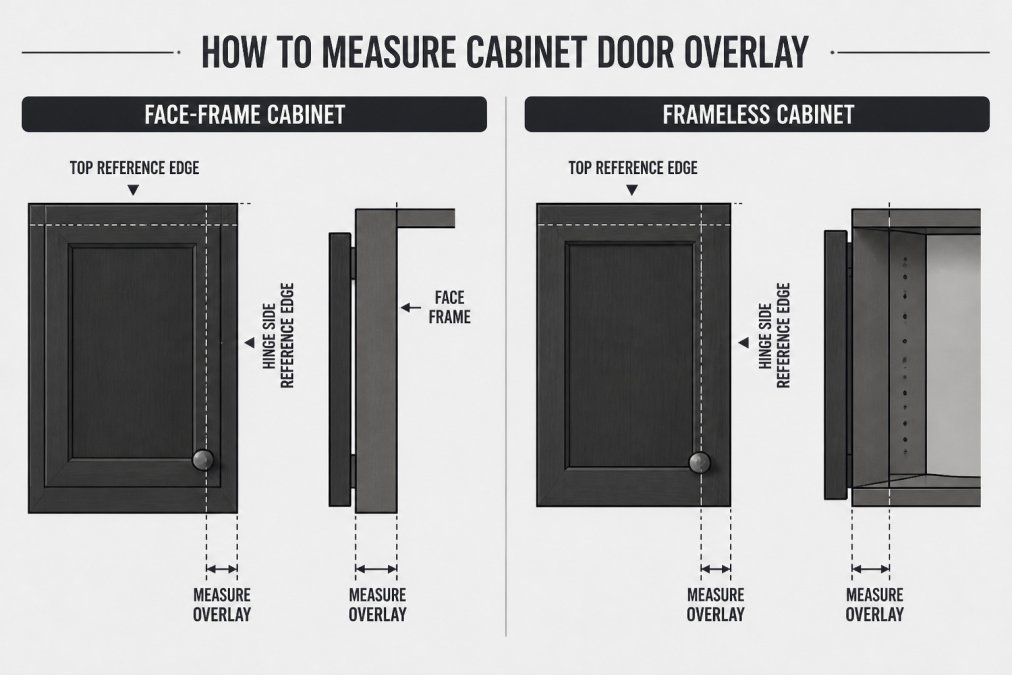
Common Measurement Mistakes
- Wrong reference edge. On a face-frame cabinet, measuring to the outer frame edge instead of the inside edge overstates the overlay by the frame width.
- Measuring with the door open. Hinge geometry changes the closed door position, so an open-door measurement is not the overlay.
- Assuming all doors match. Overlay can vary by 1/8 inch or more between cabinets.
Recording Your Measurements
Create a table with one row per door and columns for cabinet type, left/right/top/bottom overlay, and door thickness. Thickness matters because cup depth and screw length depend on it, standard doors are 3/4 inch, but older and custom doors can be 5/8 inch or 7/8 inch.
Full Overlay Cabinet Hinges: When and How to Choose Them
Full overlay hinges are the most common concealed hinge family in modern kitchens, but "full overlay" is not a single specification. Compare the kitchen units and doors these hinges would be fitted to before you buy. Two cabinets with the same door coverage can need different hinges and mounting plates depending on construction, door thickness, and desired reveal.
What Full Overlay Actually Means in Hinge Terms
A full overlay door covers nearly the entire cabinet front, leaving a reveal of roughly 1/8 inch to 1/4 inch between adjacent doors and at cabinet edges. The hinge must hold the door there while letting it swing clear of the cabinet and neighboring doors.
Full overlay hinges use an arm shape and mounting plate offset that position the door relative to the cabinet side. The hinge cup sits in a bored hole in the door, and the mounting plate attaches to the cabinet side or face frame.
Full Overlay Hinge Selection Checklist
- Confirm your measured overlay. Frameless full overlay typically falls between 5/8 inch and 3/4 inch; face-frame full overlay means the door covers all but 1/4 inch or less of the frame.
- Confirm cabinet construction. Frameless hinges mount directly to the side panel; face-frame hinges mount to the frame or a plate attached to it.
- Check cup diameter and depth. The standard European cup is 35 mm diameter with 1/2 inch depth; older or imported doors may use 26 mm or 40 mm.
- Check the mounting plate offset. Zero offset pulls the door tight; 3 mm or 6 mm pushes it outward. The correct offset depends on your measured overlay and the hinge's built-in overlay range.
- Check door thickness. Standard 3/4 inch doors work with most full overlay hinges. Doors under 5/8 inch may need a shallower cup bore; doors over 7/8 inch may need longer screws and a hinge rated for the weight.
- Check the weight rating. Check each hinge's published weight rating against the door's weight, since ratings vary by model. Two hinges are commonly used per door, and taller or heavier doors may call for a third.
- Confirm the opening angle. Most full overlay hinges open to 105 or 110 degrees. For pull-out shelves or corner access, look for 120 or 170 degrees, and verify the wider swing won't hit an adjacent cabinet or wall.
Overlay-to-Hinge Compatibility Chart
Use this chart as a starting point, then confirm against the hinge manufacturer's specification sheet. Overlay ranges vary by brand and model.
| Measured Overlay | Cabinet Construction | Typical Hinge Family | Mounting Plate Offset | Key Check |
|---|---|---|---|---|
| 5/8 to 3/4 inch | Frameless | Full overlay concealed, 110-degree | 0 to 3 mm | Cup diameter and door weight |
| 1/2 to 5/8 inch | Frameless | Full overlay or partial overlay concealed | 3 to 6 mm | Adjacent door clearance |
| 1-1/4 to 1-3/8 inch | Face-frame, 1-1/2 inch frame | Full overlay concealed | 0 to 3 mm | Frame width and plate attachment |
| 3/4 to 1 inch | Face-frame | Partial overlay concealed | 3 to 6 mm | Visible frame strip |
| 1/4 to 1/2 inch | Either | Small overlay concealed | 6 mm or specialty | Exact overlay match and paired-door spacing |
Face-Frame vs. Frameless: Which Full Overlay Hinge Fits
On a frameless cabinet, the mounting plate screws directly into the side panel, positioned by a drilling template, usually 37 mm from the front edge of the side panel for a standard 35 mm cup hinge.
On a face-frame cabinet, the hinge mounts either with a face-frame plate screwed to the front of the frame, or a side-mount plate screwed to the inside of the cabinet side with the arm reaching past the frame.
Fit and Clearance Checks Before You Drill
- Adjacent door collision. Open one door and check whether its edge swings into the neighboring door. Full overlay doors with a narrow reveal can collide if the hinge opens too wide or the doors aren't coplanar; a 110-degree hinge is less likely to collide than a 170-degree hinge.
- Wall and appliance clearance. A door next to a wall or refrigerator may not open fully. Check the swing path with the hinge temporarily held in place, or use a cardboard template cut to door size.
- Interior obstruction. Pull-out shelves, drawer fronts and interior dividers can block the hinge arm.
Common Full Overlay Mistakes
- Buying a full overlay hinge for a half overlay door. The door closes but sits off-center, and the hinge wears faster under constant lateral load.
- Wrong mounting plate offset. A zero-offset plate on a door needing 3 mm will pull the door too tight and cause rubbing.
- Skipping the cup diameter check. A 35 mm hinge won't fit a 26 mm cup hole without an adapter or new bore.
When to Choose a Different Hinge Family
Full overlay hinges are right when your measured overlay falls within the hinge's published range and your cabinet construction matches the plate style. Smaller overlay: move to partial or half overlay. Door inside the frame: move to inset. Very thin or thick door: choose a hinge series rated for that thickness.
Half Overlay Cabinet Hinges and Small Overlays
Half overlay hinges fit doors that cover only part of the cabinet frame, with a shared divider between two doors. The arm is shaped to hold the door at that partial position. Small overlays, such as 1/4 inch or 1/2 inch, need their own hinge geometry and are easy to mix up.
When measuring a small overlay, you're looking at a narrow strip of frame visible past the door edge, that strip tells you the hinge must hold the door a short distance out from the cabinet side. Use the manufacturer's overlay chart to match the number to a hinge model.
- Half overlay hinges usually need a matching mounting plate height.
- Small overlays are often mistaken for full overlay, which causes rubbing.
- Always confirm the overlay with the actual door, not a sketch.
Concealed Hinges for Overlay Cabinets: Fit, Clearance and Capacity
Concealed hinges, sometimes called European hinges, are the most common type for overlay cabinets because their hidden body lets the door sit flush, suiting modern kitchen design.
- Fit: The hinge must match your overlay measurement and your cabinet construction.
- Clearance: The hinge arm needs room to swing without hitting the cabinet interior, shelves or drawers.
- Capacity: The hinge rating must match the door weight. Heavy doors need heavier-duty hinges with more mounting screws.
Clearance problems are common with deep cabinets and tall doors, so measure the swing path before ordering.
Many owners ask whether a single hinge can carry a heavy door. In most cases two hinges per door is safer, and taller doors may need three.
Step-by-Step: Matching, Installing and Adjusting Your Hinges
- Measure overlay on every door, using the method above.
- Identify cabinet type as face-frame or frameless.
- Match the hinge to the overlay number and the hinge cup size.
- Check the weight rating against each door's weight.
- Buy a test hinge or confirm compatibility before ordering the full set.
- Mark mounting positions on the cabinet side and door, using a template.
- Drill the cup hole and the mounting-plate screw holes.
- Attach the hinge to the door first, then the mounting plate to the cabinet.
- Hang the door and check the reveal gap all around.
- Adjust the three screws: depth, side-to-side and height.
For a smooth finish, tighten the screws only after the door is aligned. Check each door after a few days, because new hinges sometimes settle slightly.
If a door still rubs or sits crooked after adjustment, check the hinge model against your overlay measurement. A mismatch is usually the cause.
| Overlay Type | Typical Cabinet Style | Best Hinge Type | Key Check |
|---|---|---|---|
| Full overlay | Frameless | Full overlay concealed | Cup size and weight rating |
| Half overlay | Face-frame | Half overlay concealed | Mounting plate height |
| Small overlay (1/4 to 1/2 inch) | Either | Small-overlay concealed | Exact overlay match |
| Inset | Face-frame | Inset hinge | Door clearance |
Booking Your Overlay Hinge Order With Frugal Cabinets Online
Once you have your overlay numbers and cabinet type, you are ready to order. Learn how to install cabinet end panels alongside your door hardware. Frugal Cabinets Online sells premium ready-to-assemble kitchen cabinets.
Before ordering, gather measurements from every door, note the cabinet style, and list each door's approximate weight. Keep that list handy when you contact us, because it speeds up matching.
For help planning your full kitchen project, visit our site to explore how to plan a kitchen cabinet layout and how to measure kitchen cabinets accurately. When you are ready to choose cabinets and doors, see our kitchen cabinet and doors buying guide for options that pair with the hinge setup you chose.
Frequently Asked Questions
How do I measure cabinet door overlay?
Measure the gap from the edge of the closed door to the edge of the cabinet opening, or measure how far the door extends past the cabinet box or face frame on each side. Record the overlay on each side separately, since a door can be offset. Full overlay means the door covers almost all of the frame, while half overlay leaves a visible strip of frame showing. A frameless cabinet typically measures from the box side to the door edge, and a face-frame cabinet measures from the frame to the door edge. Write down both sides before you choose a hinge.
Can I use concealed hinges on overlay cabinet doors?
Yes. Most concealed hinges, sometimes called European-style hinges, work on overlay doors, but you must match the hinge to the overlay amount and the cabinet type. Concealed hinges mount inside the cabinet, so they require a hinge cup in the door and a mounting plate on the cabinet side. Check the hinge's overlay rating and the door thickness before ordering, and confirm whether your cabinets are frameless or face-frame, since that changes the mounting plate position.
What is the difference between full overlay and half overlay hinges?
A full overlay hinge is designed for doors that cover nearly the entire cabinet face, usually leaving only a small reveal gap between neighboring doors. A half overlay hinge is designed for doors that cover about half of the frame, so two adjacent doors share a single frame member. Using the wrong type leaves doors misaligned or prevents them from closing fully. Measure your overlay first, then select the hinge rated for that amount.
How do I know what size overlay hinge to buy?
Start with the overlay measurement you recorded and the cabinet construction, face-frame or frameless. Then check the hinge specifications for overlay range, cup diameter, and door thickness. Pricing depends on quantity and order details, so confirm the exact hinge part on the Frugal Cabinets Online website or request a quote before you buy. Matching the hinge's overlay and mounting requirements to your cabinets prevents costly reorders.
Choosing the right hinge comes down to one decision made early: measure the overlay and match it to the hinge. Get that step right and the rest of the installation becomes straightforward. Start with your measurements, confirm the weight rating, and then place your order with confidence.


