


Kitchen Cabinet and Doors: 2026 Buying Guide

Table of Contents
- Kitchen Cabinet and Doors: What You're Actually Buying
- Kitchen Cabinet Door Styles That Define Your Kitchen
- Replacement Kitchen Cabinet Doors vs. Full Cabinet Replacement
- Cabinet Door Sizes: How to Measure and Order Correctly
- Cabinet Door Replacement Cost: What Drives Your Budget
- Materials, Finishes, and Durability Compared
- Installation, Hinge Adjustment, and Troubleshooting Fit
- Frequently Asked Questions
Last Updated: October 6, 2026
Kitchen Cabinet and Doors: What You're Actually Buying
A kitchen cabinet and doors project comes down to one decision: replace the full box, or just the face? Most homeowners assume they need both, but the boxes often stay and the doors do the heavy lifting, which is why replacement kitchen cabinet doors are the default budget move for kitchens with solid frames and tired fronts.

A kitchen cabinet is the structural box (sides, back, shelves, frame) plus the door or drawer front attached to it. Cabinet doors are the removable faces that sit on hinges and take almost all the visual wear.
Below: door styles, measuring and ordering, cost drivers, and installation and hinge adjustment so nothing sags six months in.
Kitchen Cabinet Door Styles That Define Your Kitchen
Your door profile sets the entire look of the room and is the one choice you can't easily undo. Three profiles cover most kitchens.
Shaker, Raised Panel, and Flat Front Profiles
Shaker is a five-piece door with a recessed center panel and square rails.
What most guides miss is that the profile you pick should follow your cabinet boxes, not fight them. Our U.S. Department of Energy guidance on kitchen remodeling is worth a read if you're pairing a door refresh with any efficiency upgrades at the same time.
Want to see a finish before committing? Order a sample door. We offer the Ice White Shaker and Carmel Shaker sample doors, and both are fully refundable with a full kitchen purchase.

Replacement Kitchen Cabinet Doors vs. Full Cabinet Replacement
Refacing, which means replacing doors and drawer fronts while keeping the boxes, is the cheaper path in most kitchens. Full replacement only makes sense when the boxes themselves are failing.
The deciding factor isn't age, it's condition. Open a few doors and check three things: is the frame square, do the shelves sag, has the box swollen or delaminated from moisture. If all three check out, replacement kitchen cabinet doors and matching drawer fronts get you a new kitchen for a fraction of a rebuild.
Full replacement earns its cost when boxes are water-damaged, badly out of square, or laid out in a way you want to change. If the layout works and the boxes are sound, refacing wins on budget and disruption.
| Situation | Best Approach | Why |
|---|---|---|
| Boxes square, layout works, fronts dated | Replacement doors and fronts | Lowest cost, fastest turnaround |
| Boxes sound but you want new layout | Full cabinet replacement | Layout changes need new boxes |
| Water damage or swollen boxes | Full cabinet replacement | New fronts won't fix a failing box |
| Renting or resale prep on a deadline | Replacement doors and fronts | Minimal disruption, quick visual upgrade |
Cabinet Door Sizes: How to Measure and Order Correctly
Cabinet door sizes are not the size of the opening. They're the size of the door, which is larger than the opening by the overlay amount on each side, the most common source of ordering errors.
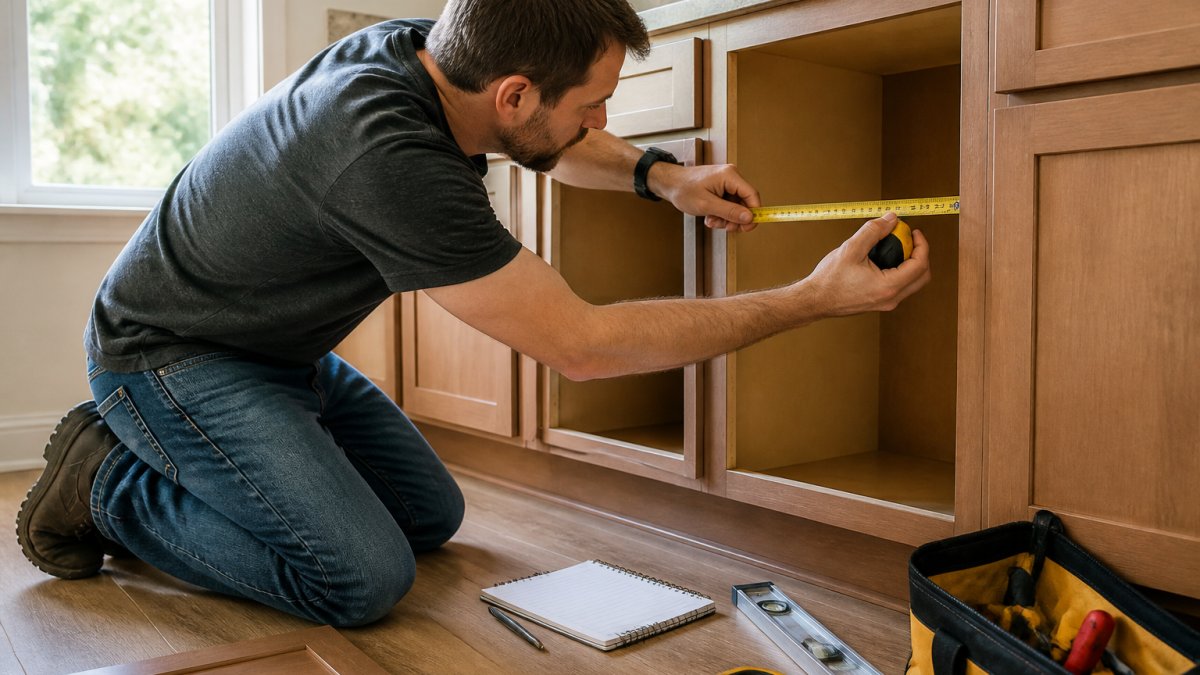
Step-by-Step Measuring for Doors and Drawer Fronts
Total time: about 30 minutes for a standard kitchen. Difficulty: beginner.
What you'll need: a tape measure, a pencil, paper or a notes app, and a helper for tall cabinets.
- Measure the cabinet opening, not the old door. Record width and height at the narrowest point.
- Confirm your overlay. Full overlay covers most of the frame; partial overlay leaves a reveal. Measure how much your current door covers the frame on each side.
- Add the overlay to the opening to get your door size. A 14-inch opening with a 1/2-inch overlay on each side means a 15-inch door.
- Measure drawer fronts separately. They're measured as a single panel and typically cover the full drawer opening plus overlay.
- Double-check every opening twice. Mark each door with a number and match it to your list before ordering.
- Order samples first if you're unsure about finish or profile.
Cabinet Door Replacement Cost: What Drives Your Budget
Most replacement-door listings show a price per door and stop there. That number is almost meaningless alone, because the same profile in the same finish lands at very different totals depending on size, drilling, and how many fronts you need.
The Four Cost Drivers, In Order of Impact
- Door count. A 30-door kitchen costs roughly twice a 15-door kitchen before any other variable. Count doors and drawer fronts separately, drawer fronts are usually cheaper because they're smaller and need no hinge boring.
- Door size. Pricing is typically tiered by size band, not by the square inch. A door that crosses into the next width or height band can jump a price tier even if it's only an inch larger. Stay inside a band and you save.
- Material tier. Paint-grade MDF sits at the low end, plywood with wood veneer in the middle, and solid hardwood, red oak, maple, cherry, hickory, at the top, with premium species carrying a further premium. Stain-grade doors cost more than paint-grade in the same species because the finish work must be flawless; you can't hide a sanding mark under stain.
- Finish and drilling. Factory-applied finish is priced into the door; hinge boring and hardware prep are often separate line items. If your existing hinges and bore positions are standard and reusable, you can skip the drilling charge entirely.
A Line-Item Budget Template
Build your estimate in this order so nothing gets missed:
- Doors (count × tiered price by size band)
- Drawer fronts (count × price)
- Hinge boring / hardware prep (per door, if not reusing existing bores)
- Hinges and hardware (per door and per drawer)
- Finish upgrade, if moving from paint-grade to stain-grade
- Samples (usually refundable against a full order)
- Shipping (often free above an order threshold)
- Sales tax
Why Quotes Are Hard to Compare
Two quotes for the same kitchen can differ widely and both be legitimate, because vendors bundle differently. One may include hinges and boring; another may list them separately. One may quote a size-banded price; another a flat per-door price that quietly assumes standard sizes. Before comparing totals, normalize the line items above and ask each vendor to break out boring, hardware, and finish separately.
Where You Can Actually Save
- Reuse hinges and bores when they're in good shape and standard.
- Stay inside size bands where the design allows.
- Choose paint-grade MDF for a smooth, uniform look at the lowest material tier.
- Order samples early. A refundable sample is far cheaper than a reorder on custom-sized doors.
- Bundle the full kitchen. Sample costs and shipping thresholds are typically tied to a full order.
Materials, Finishes, and Durability Compared
Material choice determines how your doors handle steam, splashes, heat, and daily wiping, and whether a scratch can be fixed or has to be lived with. Most listings tell you what a door is made of, rarely how it behaves five years in.
Substrate-by-Substrate Trade-Offs
Solid hardwood (red oak, maple, cherry, hickory). Takes stain beautifully and shows grain. Can be sanded and refinished down the road, making it the most repairable option.
Plywood with a wood veneer. Gives you the wood look with more dimensional stability than solid wood, since cross-grain construction resists warping. The veneer layer is thin, so deep scratches can expose the core, repairability is limited.
MDF with a painted finish. Smooth, uniform, no grain, the dominant paint-grade substrate because it paints cleanly and holds a crisp edge. It doesn't love standing water; prolonged moisture at an unsealed edge can swell the core.
MDF with thermofoil. A durable, easy-clean surface that resists moisture well and wipes down in seconds.
Durability at a Glance
| Substrate | Moisture resistance | Repairability | Maintenance | Best for |
|---|---|---|---|---|
| Solid hardwood | Moderate (seal edges) | High, sand and refinish | Occasional re-oiling or refinishing | Stain-grade, long-term ownership |
| Plywood + veneer | Good | Low, veneer is thin | Gentle cleaning | Wood look with stability |
| MDF + paint | Moderate (seal edges) | Moderate, spot touch-up | Wipe clean, avoid soaking | Paint-grade, any color |
| MDF + thermofoil | Good | Low, film can't be sanded | Wipe clean | Low-maintenance, high traffic |
Finish Matters as Much as Substrate
A factory-applied finish cures harder and more evenly than a site-applied one, which is why pre-finished doors generally hold up better than unfinished doors painted in a garage or driveway. Between two doors with the same substrate, the better factory finish usually outlasts the other.
Matching Finish to Room
- Near a dishwasher or range: favor moisture- and heat-tolerant surfaces; thermofoil and factory-finished paint handle splashes and steam better than an unfinished edge.
- High-traffic family kitchen: paint-grade MDF or thermofoil wipes clean fastest.
- Long-term ownership with refinishing plans: solid hardwood gives you the most options later.
- Stain-grade look: solid hardwood or plywood with veneer; paint-grade MDF won't show grain.
Installation, Hinge Adjustment, and Troubleshooting Fit
Installation is where a good door order either pays off or falls apart, and almost all problems trace back to hinges.
Hang doors with the hinges loosely set first, then adjust. Most European-style hinges have three adjustments: side-to-side, up-and-down, and in-and-out. Turn screws a quarter turn at a time and check the reveal after each change.
Common fit problems and their fixes:
- Door won't close flush: the hinge is set too far in; adjust in-and-out.
- Uneven gaps between doors: adjust side-to-side on one door only, then recheck.
- Door sags over time: tighten the mounting screws into the cabinet frame; if the screw holes are stripped, a slightly longer screw usually solves it.
- Drawer front sits proud: loosen the front's mounting screws, align, and retighten.
If you're coming from partial-overlay cabinets, expect more adjustment time because the reveal is more visible. Take the extra ten minutes per door, it's the difference between a kitchen that looks custom and one that looks assembled.
A kitchen refresh stalls for one reason: the measurements feel risky and the ordering feels permanent. That's the part we take the guesswork out of.
Frequently Asked Questions
What is the average cost of a kitchen cabinet door?
Cabinet door prices vary by material, size, and finish. At Frugal Cabinets Online, sample doors range from $5.40 for the Carmel Shaker to $14.99 for Signature Pearl and Ice White Shaker. Full-size doors cost more depending on dimensions and profile. Ordering samples first lets you compare color, texture, and craftsmanship before committing to a full kitchen order, which helps you avoid returns and stay on budget.
Can you replace kitchen cabinet doors without replacing the cabinets?
Yes. If your cabinet boxes are structurally sound, you can swap just the doors and drawer fronts. This is called refacing or door replacement. It costs significantly less than a full cabinet replacement and takes far less time. Check that your existing hinges and frame are in good condition first. Replacement kitchen cabinet doors from Frugal Cabinets Online are available in a wide variety of styles to fit your kitchen.
How do you measure kitchen cabinet doors for replacement?
Measure each door opening individually. For full-overlay doors, measure the opening width and height, then add the overlay amount (typically 1/2 inch on each side). For inset doors, measure the exact opening. Record every measurement separately because openings often vary by 1/8 inch or more. Double-check before ordering. Frugal Cabinets Online offers free design services to help you verify measurements and avoid costly mistakes.
What is the most popular cabinet door style in 2026?
Shaker doors remain the top choice for kitchens in 2026. Their clean recessed-panel design works with modern, transitional, and farmhouse kitchens. White and warm wood tones like white oak are the leading finishes. Frugal Cabinets Online carries Shaker options including Carmel Shaker and Ice White Shaker, plus other profiles. Order a sample door to see how the style looks in your kitchen lighting before placing a full order.

