


Plywood vs Particle Board Cabinets for Budget Kitchen Remodels

Last Updated: October 26, 2026
Quick Summary
Plywood vs particle board cabinets comes down to what is inside the box: plywood is cross-layered wood veneers, while particle board is pressed wood particles and resin. Plywood wins on durability, screw-holding strength, and moisture resistance, while particle board costs less upfront.
- Plywood grips screws across multiple wood layers, so hinges and drawer slides stay tight through daily use.
- Water damage starts at particle board's exposed edges and cut ends, where the panel swells and does not recover.
- Plywood panels start at $216 for the MX Shaker 1/4-inch panel and run to $610 for the Dover 1/2-inch panel.
- Plywood belongs in cabinet boxes, side panels, shelves, and drawer boxes; particle board is acceptable for toe kicks and filler strips.
- A mid-grade panel with good edge banding usually outperforms a high-grade panel with a raw or poorly sealed edge.
Table of Contents
- Plywood vs Particle Board Cabinets: The Core Differences
- Plywood vs Particleboard Durability: Strength, Screw-Holding, and Lifespan
- Particleboard Cabinet Moisture Resistance: Where Water Damage Starts
- Plywood Cabinet Cost: What You Actually Pay Per Box
- Furniture Board vs Plywood Cabinets: Grades, Thickness, and Edge Construction
- Component-by-Component: Where Each Material Belongs in a Cabinet
- Repairability, Indoor Air Quality, and Long-Term Maintenance
- Plan Your Project with Plywood-Built RTA Cabinets
- Frequently Asked Questions
Plywood vs Particle Board Cabinets: The Core Differences
Plywood vs particle board cabinets comes down to one question: what is inside the box? Plywood is built from thin layers of real wood glued in alternating directions, while particle board is wood particles pressed together with resin.
Below, we break down durability, moisture resistance, real cost per box, and where each material belongs in a cabinet, so you can spend your money where it actually changes the outcome.
How Plywood and Particle Board Are Made
Plywood is made by stacking thin sheets of wood veneer, rotating the grain of each layer, and bonding them with resin adhesive under heat and pressure.
Particle board, also written as particleboard, is made from wood particles and sawdust mixed with resin adhesive and pressed into a flat panel.
The short version: plywood is a layered solid composition, and particle board is a reconstituted panel. That single difference drives everything below.
Side-by-Side Comparison Table
| Factor | Plywood Cabinets | Particle Board Cabinets |
|---|---|---|
| Construction | Cross-layered wood veneers | Pressed wood particles and resin |
| Weight | Lighter for the same thickness | Heavier and denser |
| Moisture resistance | Good, handles incidental humidity | Poor, swells at wet edges |
| Screw-holding strength | Strong, holds fasteners after re-drilling | Weak, crumbles on re-tightening |
| Repairability | Sandable, patchable | Hard to repair once damaged |
| Cost per box | Higher upfront | Lower upfront |
| Lifespan | Longer service life | Shorter in wet or humid rooms |
Plywood vs Particleboard Durability: Strength, Screw-Holding, and Lifespan
Plywood wins the durability contest, and screw-holding strength is the clearest proof. A plywood panel grips a screw across multiple wood layers, so hinges and drawer slides stay tight through years of daily use.
Load-bearing capacity follows the same pattern. Plywood flexes less under heavy dishes and resists warping across wide cabinet boxes. Particle board is rigid when new, but a wet event or a heavy shelf load can leave it sagging.
Lifespan depends on where the cabinet lives. For a deeper verdict on whether the upgrade is worth it, read our review of whether plywood kitchen cabinets are worth it, and for realistic expectations, see how long kitchen cabinets last.
Particleboard Cabinet Moisture Resistance: Where Water Damage Starts
Moisture is particle board's real weak point. Water damage starts at the edges and cut ends of a panel, where exposed wood particles absorb water like a sponge.
Plywood handles incidental moisture far better because its layers limit how far water travels.
Watch out: the most common mistake is ignoring a slow leak under the sink. By the time the cabinet floor looks swollen, the panel is already failing.
Plywood Cabinet Cost: What You Actually Pay Per Box
Plywood cabinet cost runs higher per box than particle board, but the honest comparison is not a single sticker price, it is cost per box by cabinet type, thickness, and grade, plus the difference between material cost and total installed cost. Most comparisons stop at "plywood costs more," which tells you nothing about whether the upgrade pays off.
Here is how to price the decision like a contractor instead of a shopper.
Material cost vs. installed cost
Material cost is the panel price. Installed cost is the panel plus labor, edge banding, hardware, finishing, and the cost of redoing work if a box fails early.
A common pattern in remodeling: the cheaper box is replaced once during the life of the plywood box. When you divide total cost by years of service, the gap narrows or reverses.
Like-for-like cost by cabinet type
Cost depends on which component you are pricing, not just the core material:
- Base cabinet boxes: the largest cost driver. Plywood boxes carry a premium per box; particle board boxes are the budget default.
- Wall cabinets: smaller panels, so the dollar gap per box is smaller than on base cabinets.
- Shelves: plywood shelves cost more per shelf but resist sagging, so you avoid replacement.
Thickness and grade change the price
A 1/2-inch plywood panel costs more than a 1/4-inch panel, and a higher grade with fewer internal voids costs more than a utility grade. Thicker boxes resist flex better and shelves sag less, but you pay for that stiffness. When you compare quotes, confirm the panel thickness and grade on every line, a low bid often hides a thinner panel.
Finish and edge banding
Edge banding, veneer, and finish add labor and material. Plywood edges can be banded and sanded clean; particle board edges need careful sealing because a chipped edge exposes raw particles to moisture. A cheap box with poor edge construction can cost more over time than a mid-grade box with good edges.
How to budget the upgrade
Price the upgrade per box, not per kitchen. Ask for the panel thickness, grade, and edge treatment on each cabinet line, then compare total installed cost against expected service life. If budget is the deciding factor, our guide to saving on kitchen renovations with plywood cabinets shows where to spend and where to save. Our own plywood panels start at $216 for the MX Shaker 1/4" panel and run to $610 for the Dover 1/2" panel, so you can price the upgrade before you commit.
Furniture Board vs Plywood Cabinets: Grades, Thickness, and Edge Construction
Furniture board is an industry term for a particle board panel with a smooth face, often used for cabinet boxes and shelving. Furniture board vs plywood cabinets is really a question of grades, thickness, and edges, not just core material. Two cabinets can share the same core and perform very differently based on how the panel was graded, cut, and finished.
Grades: what the label actually means
Plywood is graded by face quality and by internal void content. A higher grade has fewer voids inside, which means cleaner screw grip and a flatter face under veneer.
When you compare cabinet materials, ask for the grade on the spec sheet, not just the core type. A high-grade particle board can outperform a low-grade plywood in a dry room, and a low-grade plywood can disappoint in a wet one.
Thickness: where stiffness comes from
Panel thickness drives stiffness. Boxes built from thicker panels resist flex better, and shelves sag less under heavy dishes. Thinner panels save cost and weight but need more support, especially on wide shelves and tall cabinet sides. Confirm the thickness of the box panels, the shelves, and the back panel separately, budget lines often thin the back panel first because it is less visible.
Edge construction: the failure point
Edge construction decides how a panel performs in a kitchen. Plywood edges can be banded and sanded clean, and the banded edge protects the layered core. Particle board edges are vulnerable because a chipped edge exposes raw particles to moisture, and the panel swells from the inside out. Good edge banding, applied with heat and pressure, then trimmed flush, is the difference between a box that survives a spill and one that fails at the seam.
Veneer and face quality
Veneer quality affects both appearance and durability. A thin veneer can telegraph voids underneath, while a thicker face resists sanding and wear. On painted or laminated faces, the substrate flatness matters more than the veneer itself. Ask whether the face is veneer, laminate, or melamine, and how the edges are finished to match.
What to check on a spec sheet
- Core material and grade
- Panel thickness for box, shelf, and back
- Edge banding material and application method
For the full breakdown of what separates a good panel from a weak one, read what materials make quality RTA cabinets.
Component-by-Component: Where Each Material Belongs in a Cabinet
The smartest approach is not all-or-nothing. Different cabinet components face different stresses, and matching material to component is how you protect a budget.
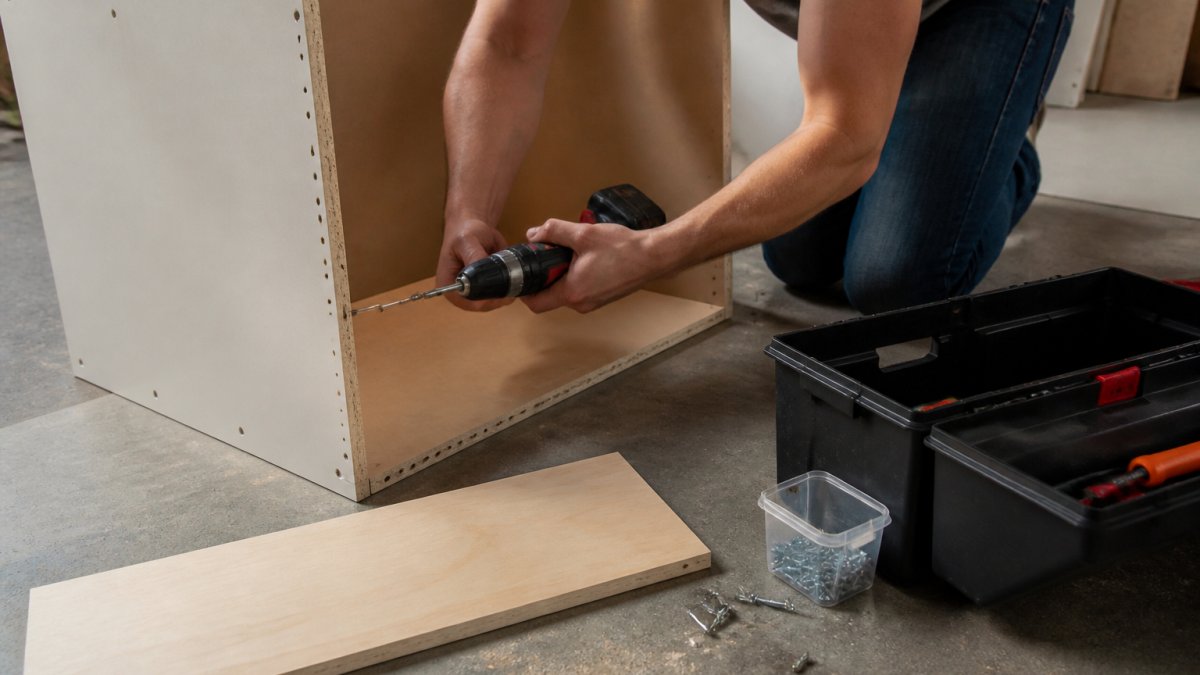
Here is where each material earns its place:
- Cabinet boxes and side panels: plywood, for screw-holding strength and moisture tolerance.
- Shelves: plywood, because it resists sagging under weight.
- Drawer boxes: plywood or solid wood, since drawers take constant pull and load.
For the full breakdown of what separates a good panel from a weak one, read what materials make quality RTA cabinets.
Repairability, Indoor Air Quality, and Long-Term Maintenance
Repairability favors plywood. A stripped screw hole can be filled and re-drilled in plywood, and minor surface damage can be sanded.
Indoor air quality is the angle most comparisons skip. Particle board uses resin adhesive, and adhesives are the source of formaldehyde concerns in composite wood products.
Maintenance is simple for both: wipe spills quickly, keep humidity steady, and check under-sink plumbing twice a year. Plywood simply gives you more margin for error.
Plan Your Project with Plywood-Built RTA Cabinets
The choice comes down to your kitchen, not a slogan. If your cabinets face steam, spills, and daily traffic, plywood boxes protect the investment. If you are outfitting a dry utility space on the tightest possible budget, particle board can do the job.
At Frugal Cabinets Online, every cabinet is built with solid wood frames and sturdy plywood construction, with soft-close functionality on select collections. Browse the Dover 1/4" plywood panel to see the material up close, or start with our design team and price your full kitchen before you decide.

Frequently Asked Questions
Are plywood kitchen cabinets worth the extra cost over particle board?
It depends on where the cabinets go and how long you plan to stay. Plywood handles moisture, screws, and re-hanging doors better, so it usually pays off in kitchens with a sink, dishwasher, or high humidity. Particle board keeps the upfront price lower and performs fine in dry, low-traffic spots. If you are remodeling for resale, plywood boxes are easier to justify because buyers and inspectors recognize the material difference.
Which cabinet material handles moisture better?
Plywood wins on particleboard cabinet moisture resistance. Plywood's crossed plies slow water absorption and hold their shape when damp. Particle board swells along exposed edges and does not return to its original thickness once wet, which can crack the veneer and loosen hinges. Sealed edges and a moisture barrier under the sink help either material, but plywood gives you more margin for error.
How much weight can particle board hold up?
Particle board carries reasonable vertical loads in a cabinet box, but its screw-holding strength is the weak point. Fasteners can pull loose under repeated door swings or heavy drawers, and the material crumbles if a screw strips out. Plywood holds screws better because the grain runs in layers, so hinges, drawer slides, and wall-mounting plates stay tight longer. For wall cabinets or anything holding cast iron, plywood is the safer choice.
Can particleboard cabinets be repaired if they get damaged?
Small dings and surface scratches can be patched with wood filler and a matching touch-up marker. Water swelling and stripped screw holes are much harder to fix because the core has already broken down. Plywood cabinet cost is higher upfront, but plywood takes a patch or a new fastener more gracefully, which stretches the life of the box. If a particle board panel has swollen past its original thickness, replacement is usually the only real fix.
What is furniture board, and is it the same as particle board?
Furniture board is a trade term for engineered panels, usually particle board or medium-density fiberboard with a wood veneer or laminate face. In furniture board vs plywood cabinets, the difference is the core: furniture board uses glued wood particles, while plywood stacks thin wood plies. Furniture board is flatter and cheaper; plywood is stronger and more moisture-tolerant. Ask the seller what the core is before you assume the label tells you.
Your kitchen will face moisture and daily wear no matter which material you choose, so the real question is how much margin you want. Frugal Cabinets Online builds RTA cabinets with plywood construction, solid wood frames, and soft-close hardware on select collections, backed by free design services and free shipping over $2,500. Get started with Frugal Cabinets Online and plan a kitchen that holds up without blowing the budget.


