


Are Plywood Kitchen Cabinets Worth It? A 2026 Review

Table of Contents
- The Verdict: When Plywood Kitchen Cabinets Are Worth the Money
- Pros and Cons of Plywood Kitchen Cabinets
- Plywood vs. Particleboard Cabinets: Strength, Weight, and Screw Holding
- Plywood vs. MDF Cabinets: Moisture, Finish, and Cost Trade-Offs
- How to Tell If Cabinets Are Plywood Before You Buy
- Total Cost of Ownership: Why the Price Premium Pays Off
- Where Plywood Matters Most in a Cabinet Box
- Conclusion: Matching Plywood to Your Budget and Use Case
- Frequently Asked Questions
Last Updated: October 21, 2026
The Verdict: When Plywood Kitchen Cabinets Are Worth the Money
Are plywood kitchen cabinets worth it? For most kitchens that see daily cooking, moisture, and heavy pots, yes. Plywood kitchen cabinets hold screws better, resist swelling from spills, and stay square longer than board-built boxes. At Frugal Cabinets Online, we build our ready-to-assemble cabinets with solid wood frames and sturdy plywood construction, so this question sits at the center of what we do.
The trade-off is real, though. Plywood costs more upfront than particleboard or MDF, and not every kitchen needs the upgrade. Below, we break down exactly when the price premium pays off and when a cheaper box makes sense.
Pros and Cons of Plywood Kitchen Cabinets
Plywood is a layered wood panel made by gluing thin sheets of wood veneer in alternating directions. That cross-grain construction is why it resists bending and holds fasteners so well.
Where Plywood Wins
- Screw holding: Layers grip fasteners across the panel, so hinges and drawer slides stay tight.
- Moisture resistance: Plywood tolerates damp better than particleboard, which swells and crumbles when wet.
- Strength-to-weight: A plywood box is stiff without being heavy, which makes installation easier.
- Repairability: Dings and chips are easier to patch than damaged particleboard edges.
Where Plywood Falls Short
- Cost: Expect a price premium over board-built cabinets.
- Edge voids: Cheap plywood can hide gaps in its core layers. Grade matters.
- Weight: It is heavier than MDF, so plan for help during installation.
Plywood vs. Particleboard Cabinets: Strength, Weight, and Screw Holding
Particleboard is compressed wood chips and resin. It is affordable and flat, but it has one serious weakness: water.
When particleboard gets wet, it swells and never fully recovers. Screws that pull out of particleboard leave crumbled holes behind. Plywood, by contrast, holds a screw through its layers and tolerates minor damp without falling apart.
Weight runs the other way. Particleboard boxes are heavier than plywood of the same thickness, which makes them harder to hang and more prone to sagging under load over time.
| Feature | Plywood | Particleboard | MDF |
|---|---|---|---|
| Screw holding | Strong | Weak | Moderate |
| Moisture resistance | Good | Poor | Fair |
| Weight | Moderate | Heavy | Heavy |
| Cost | Higher | Lowest | Middle |
| Best use | Base and sink cabinets | Budget uppers | Painted doors |
Plywood vs. MDF Cabinets: Moisture, Finish, and Cost Trade-Offs
MDF is made from fine wood fibers pressed into a dense, uniform panel. It takes paint beautifully and machines cleanly, which is why so many painted cabinet doors use it.
Where MDF struggles is water and fasteners. A leak under the sink can swell an MDF panel at the edges. Screws hold better in MDF than particleboard, but not as well as in plywood.
Our take: use MDF for painted doors and drawer fronts where a smooth finish matters, and plywood for the cabinet box where strength and moisture exposure matter. That combination gives you the best of both.
How to Tell If Cabinets Are Plywood Before You Buy
Not all plywood is equal, and a cabinet that says "plywood" on the spec sheet can still be a poor box. The goal is not just to confirm plywood; it is to confirm good plywood in the right places. Here is how to check both.
Step 1: Confirm the Box Material, Not the Frame
"Solid wood construction" usually describes the face frame, not the cabinet box. Ask specifically what the box sides, bottom, back, and shelves are made of, and get it in writing on the quote. A trustworthy supplier names the panel and the thickness.
Step 2: Read the Edge
Look at an exposed shelf edge or the inside of a side panel where it is cut.
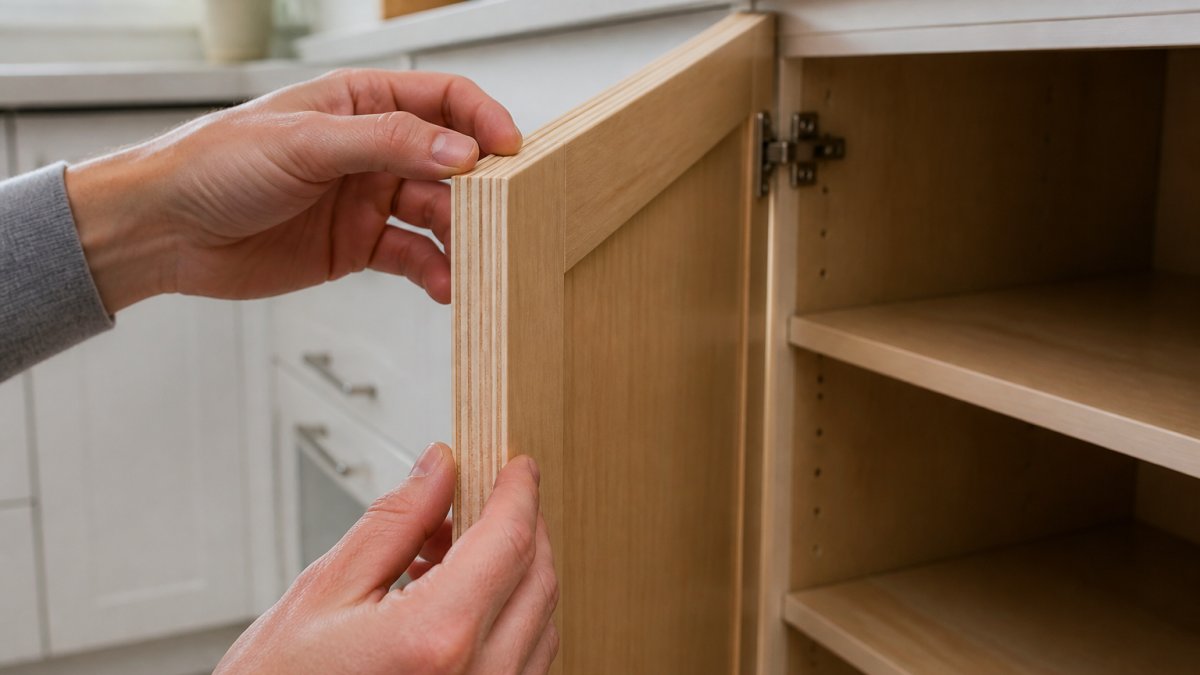
- Plywood shows thin, stacked plies running in alternating directions. More plies in the same thickness generally means a more stable panel.
- Particleboard looks like compressed chips or flakes.
- MDF looks like smooth, uniform cardboard with no visible grain.
Shine a light along the edge at a low angle. Raking light reveals gaps between plies, called voids, that flat lighting hides. Voids are weak spots and a sign of lower-grade plywood.
Step 3: Check Thickness and Where It Is Used
Thickness is a specification, not a guess. Common cabinet-box panels run around 1/2 inch to 5/8 inch, with 3/4 inch used where extra stiffness matters. Shelves and drawer boxes may use thinner stock. Ask for the thickness of each panel, because a supplier can truthfully say "plywood box" while using thinner material than you assumed.
Step 4: Inspect the Back and the Shelves
These are the panels buyers forget. A plywood box with a thin hardboard back and particleboard shelves is only partly upgraded. Check whether shelves are plywood or board, and whether they are adjustable on sturdy supports.
Step 5: Look at Edge Treatment
Cut plywood edges should be banded or sealed, especially in wet zones. Unsealed edges are where moisture gets in first. Edge banding also tells you the manufacturer cared about finish, not just the panel.
Step 6: Verify It on the Quote
When you compare quotes, line up the same specifications side by side: box material, panel thickness, shelf material, back panel, joinery method, and warranty terms. Two quotes that both say "plywood cabinets" can describe very different products. The apples-to-apples comparison is the only one that tells you which premium you are actually paying.
Total Cost of Ownership: Why the Price Premium Pays Off
Most cabinet comparisons stop at the sticker price. That is the wrong number to compare. The question that actually answers whether plywood is worth it is: what does each box cost you per year of service, including the repairs and replacements you will or will not make?
The Upfront Premium, in Real Terms
Plywood boxes typically carry a material premium over particleboard or MDF boxes. The exact dollar gap depends on the line, the finish, and the box thickness, so treat any single percentage as a starting point, not a rule. What matters is that the premium is paid once, at purchase, while the consequences of a weaker box are paid later and unpredictably.
What Failure Actually Costs
The expensive failure mode in a kitchen is not a scratched door. It is a swollen box. When particleboard or MDF takes on water at an unsealed edge, it swells and loses screw-holding capacity permanently. In a sink base, that often means the box has to be replaced rather than repaired, because the cabinet is built as a unit. Replacement cost includes the new cabinet, removal and disposal of the old one, countertop and plumbing disruption in a sink base, and labor. Even a modest sink-base replacement easily runs into four figures once labor and finish matching are included.

Plywood behaves differently. It is more moisture tolerant, not waterproof, but a plywood box that takes on minor damp usually dries out and keeps its structure. The repair is often drying and resealing rather than replacement.
A Simple Break-Even Way to Think About It
You do not need a spreadsheet to make this decision. Ask two questions:
- How likely is this box to get wet? Sink bases, dishwasher-adjacent cabinets, and anything under a frequently used prep sink carry real risk. A single avoided box replacement can cover the plywood premium across an entire kitchen.
- How long do you plan to stay? The longer the horizon, the more the durability advantage compounds. Over a short flip timeline, the math is tighter.
A common pattern among contractors and remodelers is to upgrade the wet and heavy zones to plywood and hold the line on dry uppers. That is not a compromise; it is where the return actually lives.
Where to Spend and Where to Save
For budget-focused buyers, the smart move is to spend on plywood where it counts and save elsewhere. Our Dover 1/2" plywood panel at $610.00 and MX Shaker 1/4" plywood panel at $216.00 let you spec real plywood without a custom-shop price. Our Dover sink base cabinet with tilt-outs at $663.00 puts that plywood exactly where water damage starts.


Where Plywood Matters Most in a Cabinet Box
Not every panel in a kitchen carries equal risk. Prioritize plywood in these spots:
- Sink base cabinets: The highest-moisture zone in any kitchen.
- Base cabinets: They carry countertops, dishes, and heavy pots.
- Drawer boxes: Daily open-and-close cycles stress fasteners.
- Dishwasher-adjacent cabinets: Steam and leaks find these first.
Upper cabinets that stay dry can use a board box without much risk. If your budget is tight, that is where to save.
Conclusion: Matching Plywood to Your Budget and Use Case
The honest answer to whether plywood kitchen cabinets are worth it depends on where they sit. Put plywood in the boxes that face water and weight, and you will not regret the premium.
At Frugal Cabinets Online, our ready-to-assemble cabinets pair solid wood frames with sturdy plywood construction, factory-direct pricing, free design services, and free shipping on orders over $2,500. Get started with Frugal Cabinets Online and build a kitchen that holds up for the long haul.
Frequently Asked Questions
Are plywood kitchen cabinets more durable than particleboard cabinets?
Yes, in the ways that matter most for daily use. Plywood is made of cross-laminated wood layers, so it resists bending under heavy loads and holds screws tightly even after years of door swings and drawer pulls. Particleboard is a compressed wood-fiber panel that swells when wet and loses screw grip once fasteners strip out. For a kitchen that sees daily cooking, plywood kitchen cabinets generally outlast particleboard boxes, especially around sinks and dishwashers where moisture is constant.
How can you tell if a cabinet box is made of plywood?
Open a cabinet door and look at the exposed shelf edge or the inside of the side panel. Plywood shows thin, stacked wood layers (called plies) with a visible grain running in alternating directions. Particleboard looks like compressed sawdust with a uniform speckled texture, and MDF looks like smooth, dense cardboard. You can also check the spec sheet: look for terms like 'plywood box,' 'plywood construction,' or a plywood grade like A or B. Ask the seller directly if the box, shelves, and drawer sides are plywood, not just the door.
Are plywood cabinets worth the extra cost over MDF?
It depends on where the cabinet lives. MDF takes paint beautifully and costs less, which makes it a reasonable pick for upper cabinets in a dry kitchen. But MDF swells and crumbles when water reaches the raw edge, so it is a poor fit under sinks, beside dishwashers, or in humid rooms. Plywood handles moisture far better and holds fasteners longer. If you plan to stay in the home for years, the price premium for plywood kitchen cabinets is usually money well spent.
Do plywood cabinets hold up better to moisture than particleboard?
Yes. Plywood's cross-laminated layers slow water absorption and resist swelling, while particleboard can expand and disintegrate once water reaches the raw core. That difference shows up fastest under a sink, around a dishwasher, or after a slow leak. Plywood is not waterproof, so a sustained leak will still damage it, but it tolerates humidity and occasional splashes far better. Sealing cut edges and fixing leaks quickly is still the best defense in any cabinet material.

