


What Materials Make Quality RTA Cabinets

Table of Contents
- What Materials Make Quality RTA Cabinets: The Complete Breakdown
- How Cabinet Materials Differ in Strength, Durability, and Moisture Resistance
- Solid Wood Cabinet Doors: Premium Construction and Long-Term Performance
- Plywood vs. Particleboard Cabinets: Which Performs Better
- MDF Cabinet Doors: When to Choose Medium-Density Fiberboard
- RTA Cabinet Construction Quality: Key Features That Signal Durability
- How to Inspect RTA Cabinets Before Buying: A Practical Checklist
- Environmental and Indoor Air Quality Considerations
- Conclusion: Choosing Materials That Match Your Budget and Timeline
- Frequently Asked Questions
Last Updated: October 19, 2026
What Materials Make Quality RTA Cabinets: The Complete Breakdown
Cabinet quality determines whether your kitchen remodel holds up for decades or falls apart within years. At Frugal Cabinets Online, we've helped thousands of homeowners and contractors navigate the material choices that separate durable, quality RTA cabinets from those that disappoint. These materials are measurable, verifiable, and directly tied to how your cabinets perform under daily use, moisture, and temperature shifts.
Solid wood, plywood, MDF, and particleboard each have distinct strengths and limitations. The best RTA cabinets combine the right materials for each component: solid wood frames for strength, grade-A plywood for cabinet boxes to resist warping, and quality hardware that outlasts the finish.
How Cabinet Materials Differ in Strength, Durability, and Moisture Resistance
Cabinet materials perform differently under stress, humidity, and temperature change. Solid wood expands and contracts with moisture but remains structurally sound for 20-30 years or longer when properly finished.
Moisture resistance separates quality materials from budget alternatives. Near sinks, dishwashers, and in steamy kitchens, cabinet boxes swell if they absorb water. Plywood with proper veneer sealing handles moisture well.
Strength under load matters for lower cabinets holding cookware and uppers supporting their own weight plus contents. Solid wood and plywood support substantial weight without sagging.
Match materials to each component's function. Quality RTA cabinets use engineered wood where it performs better and solid wood where durability matters most.
Solid Wood Cabinet Doors: Premium Construction and Long-Term Performance
Solid wood doors deliver timeless aesthetics and exceptional durability.
Solid wood's main limitation is movement: it expands when humidity rises and contracts when it drops, and wide panels can warp under extreme swings.
Solid wood cabinet doors typically last 20-30 years with normal use and proper finishing. Sealed with quality polyurethane or conversion varnish, they resist moisture better than MDF and can be sanded and refinished.
At Frugal Cabinets Online, solid wood doors are available in red oak and white oak finishes. Sample doors let you see the actual wood grain and color before committing to a full kitchen.

Plywood vs. Particleboard Cabinets: Which Performs Better
Plywood and particleboard are engineered wood products bonded with resin. Plywood is fundamentally superior for cabinet construction, and understanding the difference is essential when evaluating what materials make quality RTA cabinets.
Plywood Construction and Grades
Plywood is made by laminating thin wood veneers in alternating grain directions with phenol-formaldehyde or urea-formaldehyde resin.
Plywood grades range from A to D based on veneer quality. Grade-A has minimal knots and smooth veneer; grade-B allows some knots and repairs; grade-C and D have larger defects and aren't used in visible components.
Plywood thickness matters. Cabinet boxes built from 3/4-inch plywood are stronger and more rigid than 5/8-inch or 1/2-inch, resist sagging under load, and hold shelf pins more securely.
All-plywood construction means the entire cabinet box, top, bottom, sides, back, is plywood rather than a mix. All-plywood cabinets are more durable and moisture-resistant.
Particleboard Characteristics and Limitations
Particleboard is made from wood particles and sawmill waste bonded with urea-formaldehyde resin. It's flat and stable in dry conditions, making it suitable for cabinet backs and hidden components, but it cannot be used for kitchen cabinet boxes because it absorbs water and swells irreversibly.
Particleboard cabinet boxes are common in budget RTA lines because cost is low, but they fail quickly in kitchens. Moisture from sinks, dishwashers, and humidity causes swelling, and screw holes strip easily, loosening fasteners over time.
Particleboard is acceptable for cabinet backs because they're hidden and rarely exposed to moisture. It's not acceptable for cabinet boxes, doors, or drawer fronts in quality RTA cabinets.
| Material | Moisture Resistance | Strength | Lifespan | Best Use |
|---|---|---|---|---|
| Solid Wood | Good (if sealed) | Excellent | 20-30+ years | Doors, frames, visible components |
| Plywood | Excellent | Excellent | 20-30+ years | Cabinet boxes, drawer boxes |
| MDF | Poor | Good | 10-15 years | Hidden components, not kitchens |
| Particleboard | Poor | Fair | 5-10 years | Cabinet backs only |
MDF Cabinet Doors: When to Choose Medium-Density Fiberboard
MDF is made by breaking wood into fibers, mixing with resin, and pressing into dense sheets.
MDF cabinet doors work well in low-moisture environments, bathrooms, bedrooms, living rooms. In kitchens, MDF doors near sinks or dishwashers absorb steam and swell. MDF cannot be refinished like solid wood or stained like plywood.
MDF is less expensive than solid wood or plywood doors, making it attractive for budget renovations. The tradeoff is shorter lifespan and moisture vulnerability.
Quality RTA cabinets do not use MDF for kitchen cabinet boxes or doors in wet areas. MDF is acceptable for painted doors in dry rooms or as a budget option when moisture exposure is minimal.
RTA Cabinet Construction Quality: Key Features That Signal Durability
Beyond materials, construction details determine how long RTA cabinets perform. Quality RTA cabinets incorporate specific joinery, hardware, and assembly features that distinguish them from budget alternatives.
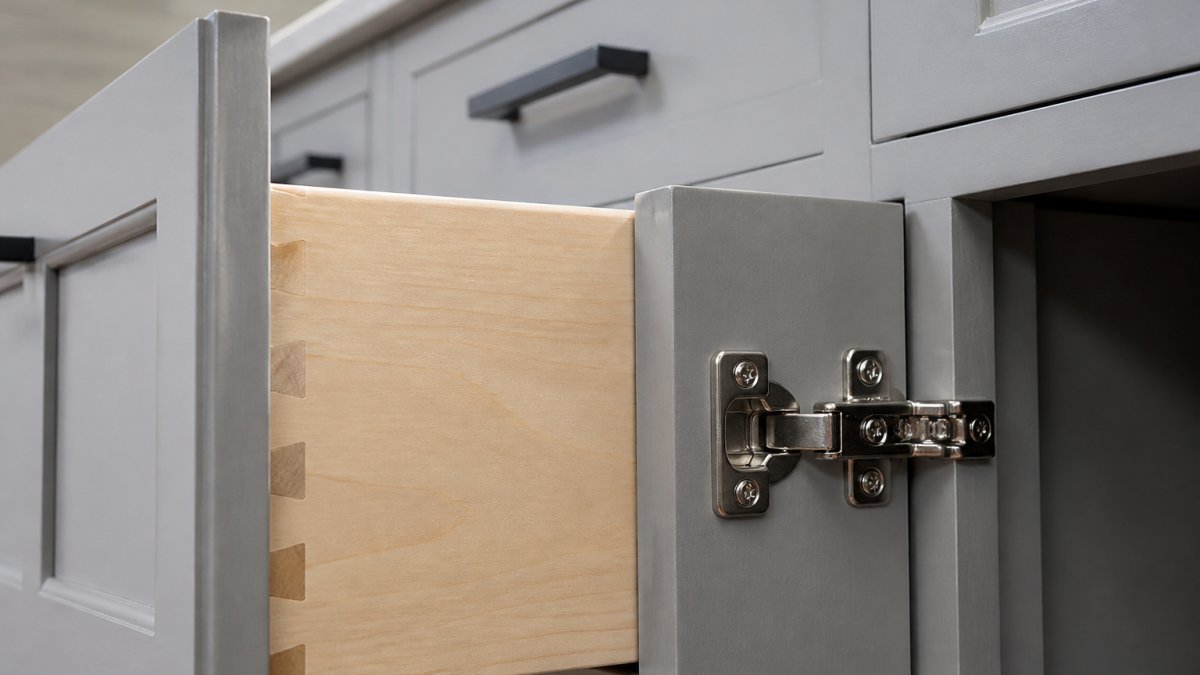
Joinery, Drawer Slides, and Hardware
Dovetail drawer joints are the gold standard for drawer box construction.
Drawer slides determine how smoothly drawers open and how much weight they support. Quality RTA cabinets use full-extension ball-bearing slides rated for 75-100 pounds.
Soft-close hinges and drawers add cost but signal quality construction. Hydraulic dampening closes doors and drawers gently, preventing slamming and extending hardware life. Soft-close hardware is optional but common in quality RTA lines.
Fasteners matter. Quality RTA cabinets use wood screws with good holding power. Budget cabinets use cam locks or dowels that loosen as wood moves.
Material Selection by Cabinet Part and Use Case
Quality RTA cabinets choose each component's material for its function:
Cabinet box: Plywood, 3/4-inch thickness, grade-A or grade-B veneer, all-plywood construction or plywood with plywood back. Never particleboard for kitchen cabinet boxes.
MX Shaker - 1/4" Plywood Panel →
Cabinet doors: Solid wood frame with plywood or MDF panels for flat doors, or all-solid-wood frame-and-panel doors.
Drawer fronts: Solid wood, plywood veneer, or MDF, matching door material for visual consistency and durability.
Drawer boxes: Plywood, 1/2-inch minimum thickness. Dovetail joints preferred. Solid wood drawer boxes are premium but unnecessary. Particleboard drawer boxes fail quickly.
Cabinet backs: Plywood or particleboard. Plywood is superior; particleboard is acceptable because backs are hidden and rarely exposed to moisture.
Face frame: Solid wood, typically the same species as doors.
Quality RTA cabinets specify materials for each component; budget lines use the cheapest material everywhere, compromising durability.
How to Inspect RTA Cabinets Before Buying: A Practical Checklist
Before ordering, verify material quality and construction details.
Check the cabinet box material. Does the spec say "all-plywood construction" or "plywood sides with particleboard back"?
Verify plywood grade. Grade-A or grade-B is acceptable; grade-C or lower is budget construction.
Check drawer joint type. Dovetail joints indicate quality; butt or dowel joints are budget construction.
Look at door material.
Examine hardware specifications. Full-extension ball-bearing slides rated for 75+ pounds are quality; light-duty or friction slides are budget.
Review warranty and return policy. Quality RTA manufacturers offer 1-year or longer warranties.
Ask about moisture resistance and finishing.
Request customer reviews. Do past buyers report durability issues, moisture problems, or hardware failure? Honest feedback reveals real-world performance.
Environmental and Indoor Air Quality Considerations
Cabinet materials are bonded with adhesives containing formaldehyde resins. Solid wood uses minimal adhesive; plywood, MDF, and particleboard all use formaldehyde-based resins. Emissions decline over time but matter for indoor air quality, especially in sealed modern kitchens.
If indoor air quality is a priority, solid wood or low-VOC plywood cabinets are preferable. Ventilation during and after installation helps dissipate emissions; after 30-60 days, off-gassing typically becomes minimal.
Conclusion: Choosing Materials That Match Your Budget and Timeline
The materials that make quality RTA cabinets are verifiable and measurable. Grade-A plywood cabinet boxes resist warping and moisture. Solid wood doors deliver durability and can be refinished. Dovetail drawer joints and ball-bearing slides outlast budget alternatives. These specifications are listed in product sheets and visible during inspection.
Budget RTA cabinets cut costs with particleboard boxes, MDF doors, butt-joint drawers, and light-duty hardware. They cost less upfront but fail faster, requiring replacement within 5-10 years. Quality RTA cabinets cost more initially but deliver 20-30 years of reliable performance, making them better value over time.
Frugal Cabinets Online offers quality RTA cabinets with solid wood frames and sturdy plywood construction at factory-direct pricing. Our MX Shaker 1/4" Plywood Panel and Dover Plywood Panels deliver the material specifications that signal durability. Request sample doors in Red Oak or White Oak to inspect wood grain, finish, and craftsmanship before ordering.


Understanding cabinet materials protects your renovation investment. The cheapest RTA cabinets rarely deliver value because they fail prematurely.
Frequently Asked Questions
What materials make quality RTA cabinets worth the investment?
Quality RTA cabinets combine solid wood frames with plywood or engineered wood construction for the cabinet box. Solid wood doors and drawer fronts provide durability and aesthetic appeal, while grade-A plywood offers superior moisture resistance compared to particleboard. Look for all-plywood construction in boxes, dovetail drawer joints, and soft-close hardware as indicators of craftsmanship. Frugal Cabinets Online's collections feature solid wood frames and sturdy plywood construction.
Is plywood better than particleboard for cabinet boxes?
Yes. Plywood resists warping, swelling, and moisture damage far better than particleboard. Plywood is made from thin wood veneers glued together in alternating grain directions, creating strength and stability. Particleboard, composed of wood chips and resins, absorbs moisture readily and deteriorates quickly in humid kitchens. For cabinet boxes that must withstand daily use and potential water exposure, plywood or all-plywood construction is the superior choice and typically justifies the higher cost through extended lifespan.
Are solid wood cabinet doors worth the extra cost?
Solid wood cabinet doors offer genuine durability and timeless aesthetics. Unlike MDF or particleboard, solid wood resists denting, handles repeated opening and closing, and can be refinished if the finish wears. Solid wood also expands and contracts naturally with humidity changes without delaminating. For homeowners planning to keep cabinets 20+ years or prioritizing repairability, solid wood doors are a worthwhile investment. Frugal Cabinets Online offers Red Oak and White Oak sample doors that combine quality craftsmanship with factory-direct pricing.
What should I look for in RTA cabinet construction to ensure quality?
Inspect for dovetail drawer joints (stronger than stapled joints), full-extension drawer slides, soft-close hinges, and solid wood frames. Verify the cabinet box material: grade-A plywood is superior to particleboard. Check edge banding quality to prevent moisture infiltration. Look for face frames that reinforce the structure. Request information about warranty coverage and lifespan claims. Quality RTA cabinets typically feature all-plywood construction, hardware that functions smoothly, and assembly instructions that reflect thoughtful engineering rather than rushed design.
How can I tell whether RTA cabinets will last?
Examine the material specifications: solid wood or grade-A plywood lasts longer than MDF or particleboard. Check the warranty length; quality manufacturers offer 5-10 year guarantees. Review construction details: dovetail drawers, soft-close hardware, and reinforced joinery indicate durability. Ask about moisture and humidity performance in the cabinet's intended location. Request sample doors to assess finish quality and wood grain consistency. Frugal Cabinets Online provides fully refundable sample doors so you can inspect materials and craftsmanship before committing to your full kitchen purchase.
What is MDF, and when should I choose MDF cabinet doors?
MDF (medium-density fiberboard) is engineered from wood fibers and resins compressed into a dense, stable board. MDF works well for painted cabinet doors in dry environments because it resists warping and accepts paint finish smoothly. However, MDF absorbs moisture readily and can swell or delaminate near sinks or dishwashers. Choose MDF for budget-conscious projects in low-moisture areas, but avoid it for drawer boxes or cabinet components near water sources. Solid wood or plywood doors are preferable for kitchens where durability and moisture resistance matter most.
Do RTA cabinets from Frugal Cabinets Online include assembly support?
Frugal Cabinets Online offers free design services to help you plan your project confidently, addressing common concerns about measuring and layout mistakes. The brand provides easy-to-assemble RTA cabinets with clear instructions, though assembly time varies by cabinet count and complexity. For detailed questions about assembly support or timelines specific to your project, contact Frugal Cabinets Online directly through their website. Their customer service team can clarify assembly expectations and connect you with resources to minimize renovation disruption.

