


How Much Do Kitchen Cabinets Really Cost?

Last Updated: October 25, 2026
Quick Summary
Kitchen cabinet cost ranges from $100 to $300 per linear foot for stock cabinets, $150 to $500 for semi-custom, and $500 to $1,500+ for custom. To calculate your kitchen cabinet cost, measure total linear feet and multiply by the per-linear-foot price for your cabinet type, then add components like drawer banks, corner units, and trim.
- Stock cabinets cost $100-$300 per linear foot; semi-custom $150-$500; custom $500-$1,500+ per linear foot.
- A typical kitchen requires 25 to 30 linear feet of cabinets around the perimeter.
- Installation labor typically costs $100-$300 per cabinet or 15-30% of cabinet cost, whichever is higher.
- Common hidden expenses include removal and disposal ($500-$2,000), delivery ($150-$500), and hardware upgrades ($500-$2,000+).
- RTA cabinets cost 20-40% less than pre-assembled equivalents because assembly is skipped.
Table of Contents
- Understanding Kitchen Cabinet Cost Ranges
- Kitchen Cabinet Cost Per Linear Foot Explained
- Stock vs. Custom Kitchen Cabinets Cost Comparison
- How Cabinet Materials and Construction Affect Your Budget
- RTA Kitchen Cabinet Cost and Assembly Considerations
- Kitchen Cabinet Installation Cost and Labor Factors
- Building Your Cabinet Estimate and Avoiding Hidden Expenses
- Start Planning Your Kitchen Cabinet Project
- Frequently Asked Questions
Understanding Kitchen Cabinet Cost Ranges
Stock cabinets run $100 to $300 per linear foot, semi-custom $150 to $500, and custom can exceed $500. These figures cover the cabinets only, not installation or components.
A laminate cabinet with particleboard construction costs far less than solid wood with dovetail joints and soft-close hinges. At Frugal Cabinets Online, we deliver premium RTA cabinets with solid wood frames and plywood construction.
Kitchen Cabinet Cost Per Linear Foot Explained
The linear foot is the standard pricing measure: 12 inches of cabinet run along your wall, measured horizontally, letting you compare stock, semi-custom, and custom cabinets on the same basis.
To calculate your kitchen cabinet cost, measure the total horizontal distance your cabinets will occupy, a typical kitchen has 25 to 30 linear feet around the perimeter. Multiply that by the per-linear-foot price for your cabinet type for a baseline estimate; the actual quote depends on cabinet count, type mix, and components.
The cabinet-only formula
Use this four-step method to move from wall measurement to a verifiable cabinet-only estimate:
- Measure each cabinet run. Record the horizontal length of every wall segment where cabinets will sit, excluding windows, doors, and appliance openings. Add the segments for total linear feet.
- Convert linear feet to cabinet count. Base cabinets are commonly 12, 15, 18, 24, 30, or 36 inches wide. Divide each run length by your average cabinet width: a 12-foot run of 24-inch base cabinets is 6 cabinets; in 18-inch cabinets, 8.
- Apply a per-linear-foot price by cabinet type. Use the cabinet-only ranges below, then adjust for the mix of base, wall, and tall units.
- Add component and trim costs. Drawer banks, corner units, pantry cabinets, fillers, and trim are priced individually, not by the linear foot, so add them after the run calculation.
Worked example: 25-linear-foot L-shaped kitchen
Assume a 25-linear-foot L-shaped layout with 15 linear feet of base cabinets and 10 linear feet of wall cabinets, using semi-custom cabinets at $300 per linear foot as a midpoint.
- Base run: 15 linear feet × $300 = $4,500
- Wall run: 10 linear feet × $300 = $3,000
- Cabinet subtotal: $7,500
Now add components the linear-foot price typically doesn't fully capture:
| Component | Quantity | Unit price | Line total |
|---|---|---|---|
| Drawer bank upgrade (base) | 3 | $150 | $450 |
| Corner base cabinet (lazy Susan) | 1 | $250 | $250 |
| Tall pantry cabinet (84-inch) | 1 | $600 | $600 |
| Fillers and scribe molding | 1 lot | $200 | $200 |
| Crown molding and light rail | 25 linear feet | $12 | $300 |
| Component subtotal | $1,800 |
Cabinet-only total: $7,500 + $1,800 = $9,300, excluding installation, countertops, hardware upgrades, delivery, and taxes. The same layout in stock cabinets at $150 per linear foot would run about $3,750 plus roughly $900 in components, near $4,650.
Why the per-linear-foot price is a starting point, not a quote
The per-linear-foot figure assumes a standard mix of base and wall cabinets with basic doors and no unusual storage. It rarely includes:
- Drawer banks and roll-out trays, which add $100 to $250 per cabinet depending on slide quality.
- Corner solutions such as lazy Susans, blind-corner pullouts, and diagonal corner cabinets, which carry a premium over standard boxes.
- Pantry and tall cabinets, which use more material and cost more per unit than a standard base cabinet.
The linear-foot estimate typically lands within 10 to 20 percent of the final cabinet-only quote for simple layouts; the gap widens with many drawers, corner units, or tall cabinets.
For a full itemized breakdown of how cabinet type, materials, and components interact, compare RTA kitchen cabinet prices and use the component list above as your quote checklist.
Stock vs. Custom Kitchen Cabinets Cost Comparison
Stock cabinets are mass-produced in standard sizes and finishes, the fastest and cheapest option at $100 to $300 per linear foot.
Custom cabinets are built for your space, cost $500 to $1,500+ per linear foot, and take 8 to 12 weeks, delivering perfect fit, unlimited finishes, and specialized storage at a premium.
Semi-custom cabinets split the difference: modular systems with more options than stock but less customization than bespoke builds, priced $150 to $500 per linear foot with 4 to 8 week lead times.
For most homeowners on a budget, our stock vs. custom kitchen cabinets cost guide provides detailed pricing breakdowns across all three categories so you can compare what fits your project scope and timeline.
How Cabinet Materials and Construction Affect Your Budget
Particleboard is the cheapest core material, common in budget stock cabinets.
Plywood uses layered wood veneers bonded together, offering superior strength and moisture resistance. Learn how plywood and other materials impact your renovation budget.
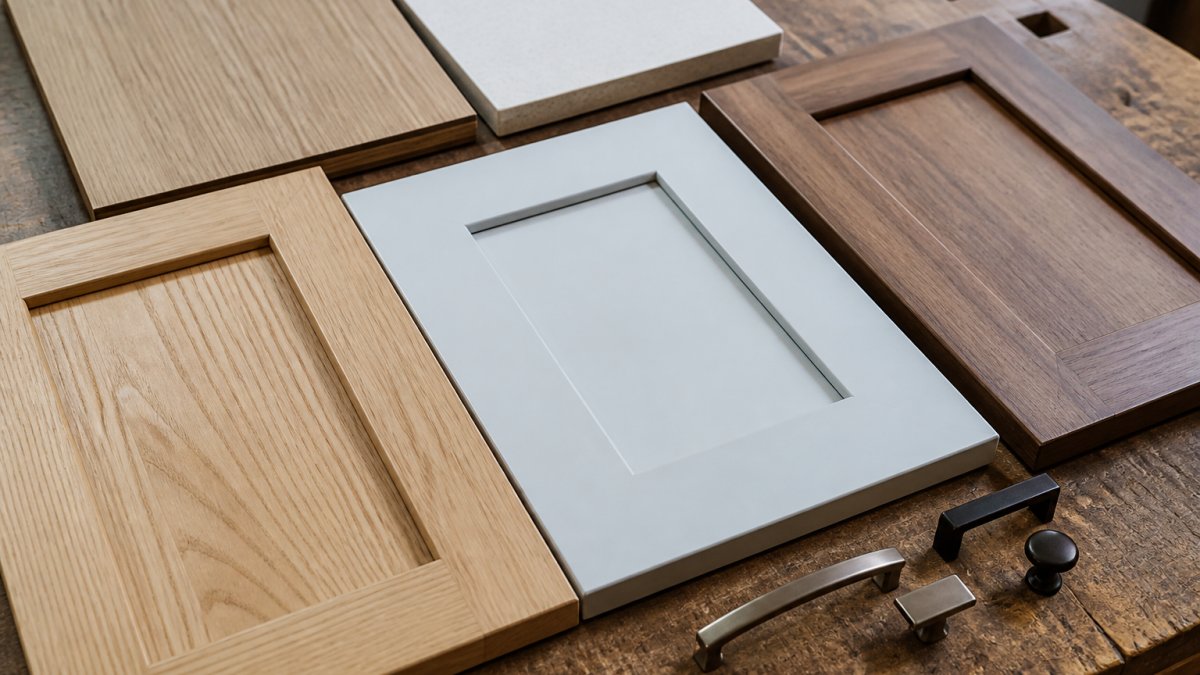
Door materials matter just as much. Solid wood doors (oak, maple, cherry) cost more but offer timeless appeal and refinishing potential.
Hardware, hinges, drawer slides, handles, adds up quickly. Basic hinges run $5 to $10 per cabinet; soft-close hinges $15 to $25 each.
For guidance on materials that balance quality and cost, explore what makes quality RTA cabinets so you understand which materials justify their price.
RTA Kitchen Cabinet Cost and Assembly Considerations
RTA (ready-to-assemble) cabinets ship flat and require home assembly, significantly reducing kitchen cabinet cost compared to pre-assembled options.
RTA cabinets typically cost 20 to 40 percent less than pre-assembled equivalents because manufacturers skip assembly and pass savings to you.
Are RTA cabinets durable?
For specific pricing on RTA options and how assembly costs factor in, compare RTA kitchen cabinet prices to see real numbers for different cabinet types and assembly scenarios.
Kitchen Cabinet Installation Cost and Labor Factors
Installation labor is a separate line item from cabinet cost and often underestimated.
Kitchen complexity matters: a galley layout takes less time than an island kitchen with angled walls and custom cutouts.
Geographic location influences labor rates: a major metro area might see $150 to $250 per hour, while a smaller market runs $75 to $125 per hour.
Standard installation takes 2 to 5 days for a full kitchen, and expedited work commands premium rates.
One often-missed expense: cabinet leveling and shimming.
Building Your Cabinet Estimate and Avoiding Hidden Expenses
An accurate kitchen cabinet cost estimate requires itemizing each component, stating your assumptions, and knowing which expenses calculators commonly omit.
Step 1: Measure and count
Begin by measuring your kitchen cabinets accurately to get exact linear footage. Measure wall lengths, accounting for windows, doors, and appliances, sketch your layout, and convert each run to a cabinet count using standard widths to prevent costly reordering.
Step 2: Build the cabinet-only subtotal
List what you're buying by category: base, wall, tall pantry, island, and specialty cabinets. Base cabinets (24 inches deep) cost more than wall cabinets (12 inches deep), and tall cabinets (84 to 96 inches) cost significantly more than standard wall height. Apply the per-linear-foot price for your cabinet type, then add drawer banks, corner units, pantries, fillers, and trim as separate lines.
Step 3: Add installation, delivery, and site costs
Installation labor is a separate line item, typically $100 to $300 per cabinet or 15 to 30 percent of the cabinet cost, whichever is higher. Delivery for a full kitchen commonly runs $150 to $500 depending on distance and order size. Add removal and disposal of existing cabinets, often $500 to $2,000.
Step 4: Add the commonly omitted expenses
| Cost Component | Typical Range | Notes |
|---|---|---|
| Stock cabinets | $100-$300/linear foot | Pre-made, quick delivery |
| Semi-custom cabinets | $150-$500/linear foot | Modular options, 4-8 week lead time |
| Custom cabinets | $500-$1,500+/linear foot | Built to spec, 8-12 week lead time |
| Installation labor | $100-$300/cabinet | 15-30% of cabinet cost |
| Hardware upgrades | $500-$2,000+ | Hinges, slides, handles |
| Countertops | $50-$200/linear foot | Separate from cabinets |
| Backsplash | $10-$50/square foot | Tile, stone, or laminate |
| Removal/disposal | $500-$2,000 | Depends on existing cabinetry |
| Delivery | $150-$500 | Varies by distance and order size |
| Sales tax | Varies by state and locality | Apply to materials and sometimes labor |
| Permits | $50-$500+ | Required for electrical, plumbing, or structural changes |
| Wall and floor repairs | $200-$2,000+ | Often discovered after demolition |
Hidden expenses catch many homeowners off guard. Cabinet removal and disposal runs $500 to $2,000; plumbing adjustments around a relocated sink add $300 to $1,000; electrical work for under-cabinet lighting or relocated outlets runs $200 to $800. Confirm your local sales tax rate before comparing quotes, and note that permits are commonly required when electrical or plumbing lines move.
Step 5: State your assumptions and validate the quote
Every estimate rests on assumptions. Write them down before comparing numbers:
- Cabinet type and price basis: stock, semi-custom, or custom, and the per-linear-foot rate used.
- Cabinet count and mix: how many base, wall, and tall units, plus drawer banks and corner units.
- Included components: whether hardware, fillers, trim, and delivery are in the price.
To validate a contractor quote, ask for a line-item breakdown separating cabinets, installation, hardware, delivery, and site work. Compare the cabinet line against your own per-linear-foot calculation. If the quote is more than 20 percent above your estimate, ask which components or site conditions explain the difference; if far below, confirm what's excluded, low quotes often omit delivery, removal, or hardware.
For guidance on materials that balance quality and cost, explore what makes quality RTA cabinets so you understand which materials justify their price, and use the line-item table above as your review checklist when comparing quotes.
Start Planning Your Kitchen Cabinet Project
Your kitchen cabinet cost estimate is now clear: you understand the price ranges, cost drivers, and hidden expenses that surprise unprepared homeowners.
Next, measure your space accurately and decide which cabinet type matches your budget and timeline. Stock is the fastest, cheapest path; semi-custom gives you options without the custom price; custom delivers perfect fit and unlimited design freedom at a premium.
At Frugal Cabinets Online, we specialize in premium RTA cabinets that deliver quality without the markup. We offer free design services to help you plan your layout correctly the first time, and our sample doors let you see finish quality before committing to a full order. With flat 50% off on premium cabinets and free shipping on orders over $2,500, you can plan your project and get started today.

Frequently Asked Questions
How much are kitchen cabinets by the foot?
Kitchen cabinet cost per linear foot ranges from $75 to $300+, depending on quality tier. Stock cabinets average $75-$150 per linear foot, semi-custom options run $150-$250, and custom cabinets exceed $250. Your total kitchen cabinet cost depends on total linear footage needed and the quality level you choose.
How do I calculate the cost of kitchen cabinets?
Measure your total linear footage by adding the width of all cabinet runs (base and upper combined). Multiply by the per-foot price for your chosen cabinet type. Add 15-20% for specialty pieces like lazy susans or corner cabinets. Include installation labor separately. Many homeowners use a kitchen cabinet cost calculator or request a free design estimate to validate measurements before purchasing.
What factors affect the cost of kitchen cabinets most?
Material choice (solid wood vs. laminate), cabinet construction quality, customization level, kitchen size, and installation complexity drive cost. RTA cabinets cost less upfront but require assembly time. Custom cabinets offer flexibility but carry premium pricing. Regional labor rates and delivery fees also impact your final kitchen cabinet cost estimate.
How much should I budget for kitchen cabinet installation?
Kitchen cabinet installation cost typically ranges from $3,000 to $10,000 for a full kitchen, depending on complexity and regional labor rates. Simple replacements may cost $2,000-$4,000, while extensive modifications or custom layouts can exceed $12,000. Always get quotes from local installers and factor this into your total kitchen remodel budget separately from cabinet purchase price.
The path forward is straightforward: measure accurately, understand your cabinet type options, account for all costs including installation and hidden expenses, and choose a supplier that delivers quality at fair pricing. Your dream kitchen doesn't require a premium budget, it requires smart planning and the right partner.


