


Stock vs Custom Cabinets Cost: 2026 Price Guide

Table of Contents
- Stock vs Custom Cabinets Cost: A Side-by-Side Comparison
- Stock Kitchen Cabinets Cost: What You'll Actually Pay
- Custom Kitchen Cabinets Cost: The Full Price Breakdown
- Semi-Custom Cabinets Cost: The Middle Ground
- How to Save Money on Kitchen Cabinets Without Sacrificing Quality
- Hidden Costs and Total Project Budget: What Estimates Leave Out
- How to Choose the Right Cabinets for Your Kitchen and Budget
- Frequently Asked Questions
Last Updated: October 12, 2026
Stock vs Custom Cabinets Cost: A Side-by-Side Comparison
The stock cabinets vs custom cabinets cost gap is the biggest line item in most kitchen budgets, and the most misunderstood.
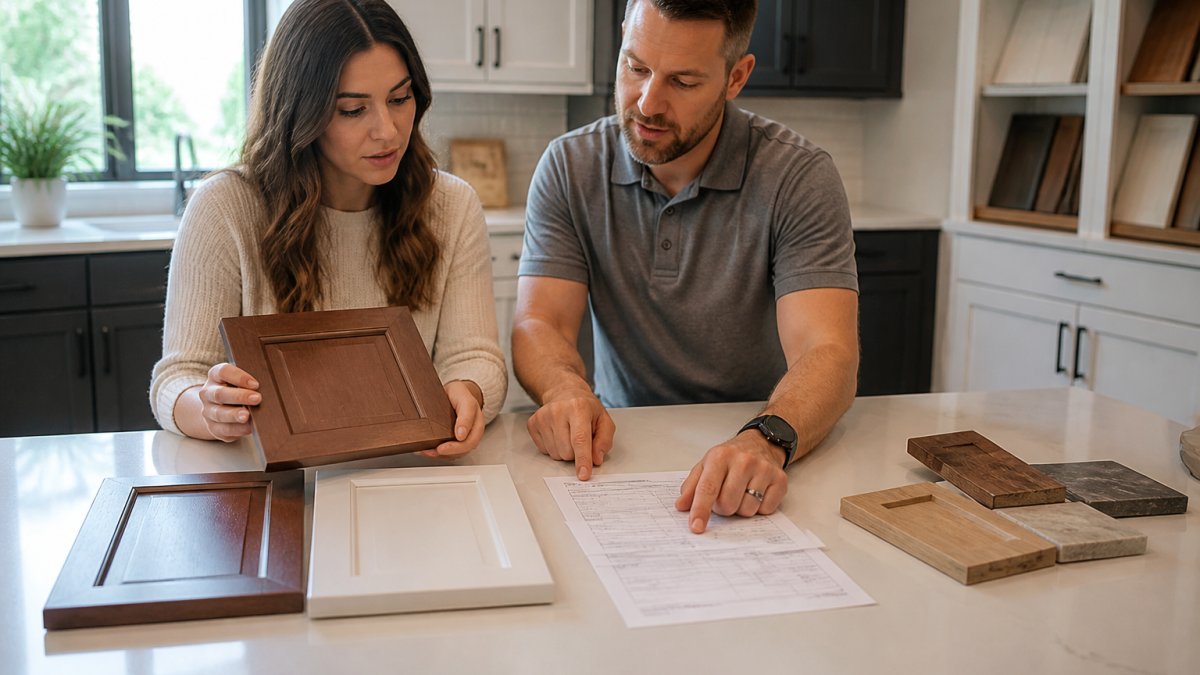
At Frugal Cabinets Online, we sell ready-to-assemble (RTA) cabinets, which sit in the stock and semi-custom tier on price while allowing finish and layout choices factory stock rarely offers.
Stock cabinets cost the least per box and arrive fastest. Custom cabinets cost the most and take the longest.
| Factor | Stock | Semi-Custom | Custom |
|---|---|---|---|
| Availability | In stock, ships now | Made to order | Made to order |
| Sizes | Predetermined measurements | Standard sizes plus modifications | Any custom dimension |
| Lead time | Days | Weeks | Months |
| Design flexibility | Low | Medium | Highest |
| Best for | Small kitchens, rentals, tight budgets | Most remodels | Irregular layouts, high-end builds |
Stock Kitchen Cabinets Cost: What You'll Actually Pay
Stock kitchen cabinets cost the least of the three tiers because they are mass-produced in standard widths and depths, then warehoused. You pick from whatever sizes and finishes are on the shelf, and the price reflects that lack of choice.
A few things drive the final number:
- Linear footage. Cabinet pricing is usually quoted per linear foot of wall run. A small kitchen with 10 linear feet of cabinets costs far less than a large kitchen with 30.
- Box construction. Particleboard boxes cost less than plywood. This is where cheap stock cabinets earn their reputation for sagging.
- Door style and finish. A painted or thermofoil door costs less than a stained hardwood door.
The trade-off is real. Stock cabinets are affordable and available immediately, which matters when minimizing renovation disruption. The catch: you build your layout around the boxes that exist, not the other way around.
Custom Kitchen Cabinets Cost: The Full Price Breakdown
Custom kitchen cabinets cost the most because a cabinetmaker builds each box to your exact specifications. Every dimension is custom, every door style is your choice, and every finish is mixed for your order. But "the most" is not a number, and most estimates are not comparable to a stock quote because they bundle different things.
What a custom quote is actually made of
A custom cabinet price is a stack of line items, and each one moves the total:
- Design and field measure. A designer measures your space, drafts the layout, and coordinates with the shop, often billed as a design fee or rolled into the cabinet price.
- Box construction. Solid hardwood frames and plywood boxes cost more than particleboard or MDF. Box material is the single biggest driver of how long the cabinets last.
- Door and drawer fronts. A painted MDF door costs less than a stained hardwood raised-panel door; a five-piece door with applied molding costs more than a slab.
How custom pricing is quoted
Custom shops quote in one of three ways, and the method changes how you compare bids:
- Per linear foot of wall run. Common for a full kitchen. The per-foot rate drops as the run gets longer because fixed design and setup costs spread across more boxes.
- Per box or per cabinet. Common for islands, vanities, and one-off pieces. This is the easiest format to compare against a stock or RTA quote because you can match box for box.
- Per project, lump sum. Common for high-end builds. This is the hardest to compare because the scope is buried in the total.
A like-for-like comparison you can actually run
To compare a custom quote against a stock or semi-custom quote, ask each supplier for the same five things:
- The cabinet count and the linear footage the price covers.
- The box material and thickness.
- The door style, material, and finish.
- Whether hardware, fillers, trim, delivery, and installation are included.
- The lead time and the deposit terms.
A custom quote that looks 40% higher than a stock quote may be closer once you add the stock quote's missing delivery, hardware, trim, and installation. The reverse is also true: a competitive-looking custom quote may exclude installation, a separate skilled trade.
Where custom earns its premium
The upside is fit and functionality. Custom cabinetry solves awkward corners, odd ceiling heights, and space constraints stock cannot. If a wall is out of square or a window cuts into the run, custom is often the only clean answer.
The downside is time. Custom orders can take months, and a shop delay pushes your whole renovation back. For a homeowner on a tight timeline, lead time is often the deciding factor, not price.
When custom is the wrong buy
Custom is the wrong buy when the layout is standard. If your walls are square, your ceiling is level, and your run uses common widths, you are paying a premium for dimensions you do not need. Semi-custom or RTA cabinets with fillers deliver the same fit for less. Reserve custom for the one or two spots where standard sizes genuinely fail, a corner, an island, or a run wrapping an obstruction.
Semi-Custom Cabinets Cost: The Middle Ground
Semi-custom cabinets cost more than stock and less than full custom, and for most kitchen remodels they are the sensible middle.
Think of it as stock cabinets with options: you can usually adjust depth, add a filler to close a gap, and choose from a wider finish palette.
This is the tier where RTA cabinets live, and it is where we focus. You can order a sample door to check the finish and construction before committing to a full kitchen, and our sample doors are fully refundable with a full kitchen purchase.

For a small kitchen where every inch matters, a semi-custom line lets you close gaps with fillers rather than paying for a custom build.
How to Save Money on Kitchen Cabinets Without Sacrificing Quality
Knowing how to save money on kitchen cabinets comes down to spending where it shows and saving where it does not. The door is what you see and touch; the box behind it holds the weight. Put your budget into the box and hardware, and go cheaper on the finish.
US Shaker - Wall Open Cabinet →
Strategies that work:
- Choose RTA over pre-assembled. You trade your own assembly time for a lower price, and assembly is straightforward with basic tools.
- Standard sizes first. Design your layout around standard cabinet sizes and use fillers only where you must. Every custom dimension adds cost.
- Buy samples before you buy cabinets. A sample door costs a few dollars and prevents an expensive finish mistake. Our Gramercy White sample door lets you see the color and texture in your own kitchen light.
Hidden Costs and Total Project Budget: What Estimates Leave Out
Most cabinet estimates quote the boxes and stop there. The total project cost is almost always higher, and the gap between estimate and final bill is where budgets break. Here is the full picture, both one-time costs and the lifetime costs that decide whether a cheaper cabinet actually saves you money.

The ancillary costs that show up after the quote
These are the line items that turn a cabinet price into a project price:
- Delivery and freight. Heavy cabinet shipments are not free unless the seller says so. RTA cabinets ship flat and cost less to move than assembled boxes, one reason they land lower on total cost.
- Assembly. Pre-built cabinets arrive assembled. RTA cabinets do not, so budget your own time or a handyman. Assembly is straightforward with basic tools, but it is real labor.
- Installation labor. Hanging cabinets level and true is skilled work, billed separately from the cabinet price. The rate depends on your market and the complexity of the run.
A sample estimate framework you can fill in
You do not need a calculator to sanity-check a quote. Use this framework with your own numbers:
- Count your cabinets. Write down every base, wall, and tall cabinet you need.
- Measure your linear footage. Add up the wall runs where cabinets will hang.
- Pick a finish level. Painted or thermofoil is the low end; stained hardwood is the high end.
- Add the ancillary list above. Delivery, assembly, installation, countertops, trades, removal, and trim.
- Add a contingency. A common pattern is to hold back a percentage of the total for surprises behind the walls.
The point is not to predict the exact bill. The point is to see which tier fits before you fall in love with a door style.
Total cost of ownership: the part most buyers miss
The sticker price is only the first cost. What you pay over the kitchen's life depends on four things:
- Repairability. A stock or RTA cabinet with a standard hinge and drawer glide can be repaired with a part you can order. A custom cabinet with a proprietary hinge may need a shop visit.
- Replacement parts. If a door is damaged, can you buy one in the same finish, or must you replace the whole run? Ask before you buy, because finish batches change over time.
- Durability. A particleboard box with a thin back panel will sag under the weight of dishes within a couple of years. A plywood box with a solid frame will not. The cheaper box often costs more to replace.
How to compare quotes like-for-like
The honest way to compare quotes is to ask each supplier what is included: delivery, assembly, hardware, trim, and installation. A lower cabinet price with delivery and hardware billed separately can cost more than a higher all-in price. Put the quotes side by side and add missing line items before you decide.
Where the money actually goes
A useful rule of thumb: cabinets are one part of the kitchen budget, not the whole thing. Countertops, appliances, flooring, lighting, and labor each take a share. Spend the entire budget on cabinets and you will not have enough left for the trades that make them usable. Decide your total project number first, then work backward to a cabinet tier that leaves room for everything else.
How to Choose the Right Cabinets for Your Kitchen and Budget
The right choice depends on three things: your kitchen layout, your timeline, and how much work you will do yourself. There is no single best tier, only the best fit.
Use this decision framework:
- Small kitchen, tight budget, fast timeline: stock or RTA. Work with standard sizes and accept fewer finish options.
- Standard layout, moderate budget, some lead time: semi-custom. More door styles and finishes, still affordable.
- Irregular layout, high-end build, no rush: custom. You pay for exact fit and unique design.
A mixed approach often wins.
Before you commit, order a sample door in the finish you are considering. Our Malibu Espresso sample door and Signature Pearl sample door let you compare tones side by side in your own space. If you need an open wall unit to break up a run of closed cabinets, our US Shaker wall open cabinet is a stock-friendly way to add display space without a custom build.

For more on comparing cabinet construction and materials, the U.S. Environmental Protection Agency's guidance on indoor air quality and building materials is a useful reference when you are evaluating finishes and adhesives.
The hardest part of a kitchen remodel is not choosing a door style. It is keeping the total project cost from drifting past your budget while still getting cabinets that hold up.
Frequently Asked Questions
How much do stock cabinets cost compared with custom cabinets?
Stock cabinets generally cost less per linear foot than custom cabinets. Semi-custom options, like RTA cabinets, typically fall in the middle. The gap widens further once you add installation, hardware, and trim.
Are custom kitchen cabinets worth the extra cost?
Custom cabinets make sense when your kitchen has unusual dimensions, you need a specific finish or door style, or you plan to stay in the home long-term. If your layout is standard and your budget is tight, stock or semi-custom cabinets deliver similar functionality for far less. Many homeowners put the savings toward countertops, appliances, or professional installation instead.
What is the difference between stock, semi-custom, and custom cabinets?
Stock cabinets come in predetermined sizes and are ready to ship, usually within days. Semi-custom cabinets use standard sizing but allow modifications like depth changes, door style swaps, and finish options, with lead times of four to eight weeks. Custom cabinets are built to your exact design specifications, can fit any space constraint, and take eight to sixteen weeks or longer. Cost, flexibility, and lead time all scale together.
Can stock cabinets be customized to fit an unusual kitchen?
Stock cabinets cannot be resized, but you can work around odd spaces with filler strips, open shelving, or a wall open cabinet like the US Shaker Wall Open Cabinet at $289. A designer can also mix stock sizes to cover most layouts. For truly irregular walls or ceilings, semi-custom or custom is the better fit. Measure carefully before ordering and use a free design service if available.
What costs should I include when budgeting for new kitchen cabinets?
Beyond the cabinet price, budget for delivery, assembly (if RTA), installation labor, hardware upgrades, filler panels, crown molding, toe kicks, and old cabinet removal. Add 10 to 15 percent for unexpected issues like uneven walls or plumbing adjustments. Sales tax and shipping also add up. A $5,000 cabinet order can easily become $7,500 to $8,500 once every line item is counted.

