


5 Ways to Choose Durable Kitchen Cabinets

Last Updated: October 23, 2026
Quick Summary
Durable kitchen cabinets are built from quality materials like solid wood or plywood, constructed with reinforced frames and proper joinery, equipped with hardware rated for tens of thousands of cycles, finished with moisture-resistant coatings, and backed by warranties that reflect the manufacturer's confidence in longevity.
- Solid wood and plywood resist moisture and wear far better than particleboard, which swells when exposed to humidity and cannot be repaired.
- Cabinet boxes should use 3/4-inch plywood with horizontal interior bracing, dovetail joinery in drawers, and reinforced backs to prevent sagging and misalignment.
- Hardware cycle ratings and load capacities matter more than marketing claims; hinges rated for 50,000 cycles and slides rated for 75-100 lb are common residential standards.
- Sealed edges and finished interiors near sinks and dishwashers prevent water from entering the core material and causing permanent damage.
- Warranties covering structural failure, finish defects, and hardware failure for a substantial period signal manufacturer confidence in durability.
Table of Contents
- 1. Evaluate Durable Kitchen Cabinet Materials
- 2. Inspect Kitchen Cabinet Construction Quality
- 3. Check for Soft-Close Cabinet Hinges and Drawer Slides
- 4. Assess Finish Quality and Moisture Resistance
- 5. Verify Durability Through Warranties and Maintenance
- Five-Point Inspection Checklist for Durable Cabinets
- Frequently Asked Questions
1. Evaluate Durable Kitchen Cabinet Materials
Material choice is the foundation of durable kitchen cabinets, determining how well they resist moisture, wear, and time. Material quality can separate cabinets that last 20 years from those that fail in five.
Solid Wood and Hardwood Durability
Solid wood and hardwood cabinets are the most durable option. Oak, maple, cherry, and walnut are naturally dense and resist dents, scratches, and moisture better than engineered alternatives.
The real advantage is repairability: a dent or scratch can be sanded out and refinished, while engineered-material damage is permanent.
The trade-off is cost and maintenance. Solid wood requires regular finishing to maintain moisture resistance.
Plywood vs. Particleboard Cabinets
Plywood and particleboard are engineered woods. Plywood is significantly more durable: cross-grain veneer construction creates strength and prevents warping.
Particleboard is compressed wood particles held with resin, cheaper but far less stable. It swells when exposed to moisture, even humidity from a dishwasher or sink, and cannot be repaired once swollen.
For kitchen cabinets, plywood is the engineered wood choice that actually lasts.
We recommend exploring What Materials Make Quality RTA Cabinets to understand how material choices affect long-term performance, and Are Plywood Kitchen Cabinets Worth It? A 2026 Review for a deeper comparison of plywood-specific durability.
Engineered Wood and MDF Considerations
MDF and HDF are wood fibers compressed under heat and pressure. MDF is denser than particleboard and holds screws better; HDF is denser and more stable.
Some manufacturers offer HDF-HMR (moisture-resistant treatment), a middle-ground option more durable than standard MDF but less reliable than solid wood or plywood.
The practical rule: use MDF and HDF for cabinet doors and decorative panels where appearance matters.
2. Inspect Kitchen Cabinet Construction Quality
Construction quality determines whether cabinets hold up under daily use or fall apart in a few years. Two cabinets made from the same material can have vastly different lifespans based on how they're built.
Cabinet Box and Frame Construction
The cabinet box is the structural skeleton.
Face-frame construction is more forgiving: a sagging door can be fixed by shimming the frame or adjusting hinges. Frameless is more space-efficient but less forgiving of manufacturing tolerances.
More important is the box itself: sides, top, and bottom should be solid plywood at least 3/4 inch thick, since thin particleboard flexes and cracks under the weight of dishes. The back should be reinforced plywood, not thin hardboard, a weak back lets the cabinet rack and doors misalign.
Cabinets taller than 30 inches should have horizontal interior braces to prevent sides from bowing under load; without them, the cabinet weakens and doors bind.
Drawer Box Construction and Joinery
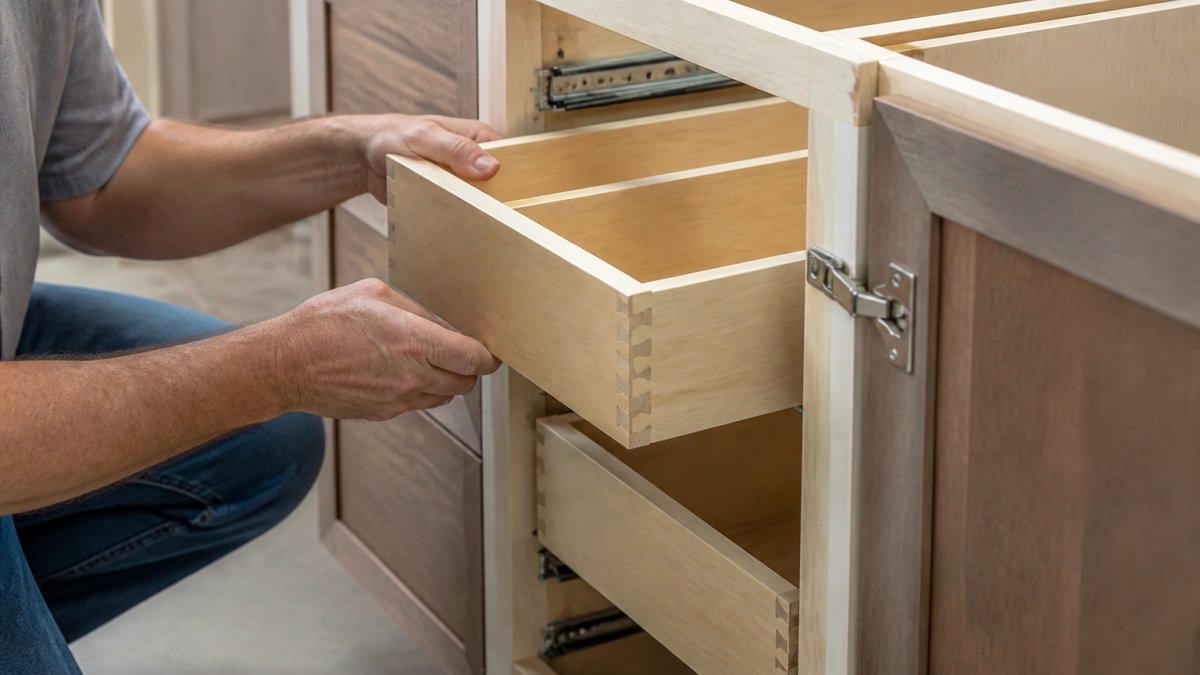
Drawers take more abuse than any other component. Quality drawers use dovetail or box-joint joinery, which locks sides together and distributes stress evenly; butt joints fail faster under repeated use.
The drawer bottom should be plywood, not thin hardboard, which flexes and sags until drawers bind.
Drawer sides should be solid wood or quality plywood at least 5/8 inch thick; thin sides flex under load, stressing joints and hinges until the drawer loosens and fails.
3. Check for Soft-Close Cabinet Hinges and Drawer Slides
Hardware is where durable cabinets are won or lost. Hinges and slides take every cycle of daily use; a premium plywood cabinet still feels broken in five years if hardware is underspecified. Judge hardware by specification, not feel.
Read the Hardware Specifications, Not the Marketing
Most listings say "soft-close" and stop there, which tells you almost nothing. Ask for the actual hardware model and manufacturer, then compare these numbers:
- Cycle rating. Quality hinges and slides are tested to a rated number of open-close cycles. Residential hardware commonly carries ratings in the tens of thousands of cycles, while commercial-grade components are rated far higher. A hinge rated for 50,000 cycles and one rated for 200,000 cycles can look identical on the showroom floor. Ask for the rating in writing.
- Load capacity. Drawer slides carry a weight rating, often expressed in pounds per pair. Standard slides may be rated around 75-100 lb, while heavy-duty slides are rated considerably higher. A drawer loaded with cast-iron cookware or a full set of dinnerware needs a slide rated well above the weight it will actually carry, because repeated overload shortens slide life dramatically.
- Hinge type and adjustment. Concealed European-style hinges with three-way adjustment (side, depth, and height) let you correct door sag without replacing hardware. Cheaper hinges offer limited or no adjustment, so a door that drifts out of alignment stays out of alignment.
Why Soft-Close Is a Durability Feature, Not a Luxury
A slammed door sends shock loads through the hinge, frame, and joints; over hundreds of slams a year, that loosens screws, fatigues metal, and stresses the box. Soft-close hardware absorbs that energy and releases it gradually, but only if the underlying hardware is rated for the cycles it will see.
Match Hardware to the Zone and the Load
Hardware needs differ by zone: drawers under the cooktop need heavy-duty slides, upper doors near the sink need corrosion-resistant hinges, and a pantry that opens dozens of times a day benefits from the highest cycle rating you can afford. Count how often each cabinet will open before you spec hardware.
What to Check in Person
Open and close every door and drawer on a display unit: motion should be smooth and quiet, with no grinding, wobble, or side-to-side play.
Kitchen Cabinet Manufacturers Association hardware and performance standards publishes voluntary performance standards that address hinge and slide testing, which is a useful reference when a seller's claims sound too good to verify.
For reference, Dover - Soft Close Rollout Trays exemplify the quality hardware that extends cabinet lifespan through smooth, controlled operation.

4. Assess Finish Quality and Moisture Resistance
The finish is the cabinet's first line of defense against moisture. Competitors describe finishes with adjectives, durable, premium, furniture-grade, without giving buyers a way to compare. Evaluate finish and moisture resistance by zone, by specification, and by repairability.
Compare Finish Types on Real Performance
Cabinet finishes fall into a few families, and they behave differently in a kitchen:
- Conversion varnish and catalyzed lacquer. These are two-part finishes that cure hard and resist moisture, heat, and common household chemicals well. They are common on factory-finished cabinets and are generally the most durable spray-applied option for kitchen use.
- Polyurethane. A tough, widely used finish with good moisture and abrasion resistance. Water-based polyurethane is lower in odor and emissions; oil-based polyurethane cures harder but yellows over time. Both outperform shellac and basic lacquer in wet areas.
- Lacquer. Produces a smooth, repairable surface and is common on painted and stained cabinets, but standard lacquer is softer and less moisture-resistant than conversion varnish. It burns or blushes when exposed to alcohol and standing water.
Ask what finish system is used, how many coats are applied, and whether edges and interiors are sealed. A finish that stops at the visible face leaves the door's back and edges exposed to steam and splashes.
Test Moisture Resistance Where It Matters
Moisture damage rarely starts on a flat door face, it starts at seams, edges, the sink cabinet, and the dishwasher bay. When evaluating cabinets:
- Look for sealed or banded edges on doors and box panels. Exposed particleboard or MDF edges wick water.
- Check whether the cabinet box interior is finished or at least sealed. An unfinished interior near a sink or dishwasher invites swelling.
- Ask whether the manufacturer offers moisture-resistant core options for sink-base and dishwasher-adjacent cabinets. Some lines offer treated cores specifically for wet zones.
Field test a sample: place a few drops of water on an exposed edge and the finished face, wait several minutes, and wipe. A sealed edge beads water; a raw edge darkens and softens, a quick way to separate sealed construction from cosmetic finishing.
Judge Repairability, Not Just Durability
Even a great finish gets scratched eventually; the question is whether it can be repaired. Conversion varnish and lacquer can be touched up and blended, and painted surfaces recoated. Thermofoil and laminate wraps generally cannot be repaired invisibly once they lift or tear, the door usually must be replaced. Solid wood and veneered doors can be sanded and refinished, while MDF doors with damaged edges are hard to restore.
Match the Finish to the Zone
Finish performance depends on location: prioritize moisture resistance and sealed edges near the sink and dishwasher, heat resistance and easy cleaning around the range, and abrasion resistance in high-traffic drawers and doors.
The Dover - Touch Up Kit is designed for maintaining cabinet finishes, which speaks to the importance of protecting your investment through proper care and minor repairs.

5. Verify Durability Through Warranties and Maintenance
Read it carefully: some cover only manufacturing defects, not normal wear, and others exclude water damage or improper installation.
Ask the manufacturer directly about expected lifespan under normal use, required maintenance, and how often hinges should be tightened or finishes resealed.
Maintenance directly impacts durability.
How Long Do Kitchen Cabinets Last? A 2026 Guide explores the relationship between maintenance, warranty coverage, and actual cabinet lifespan in detail.
Five-Point Inspection Checklist for Durable Cabinets
Use this checklist when evaluating kitchen cabinets before purchase. Each point represents a critical durability factor.
| Inspection Point | What to Check | Red Flags |
|---|---|---|
| Material composition | Cabinet box and frame material | Particleboard box, thin veneer, unspecified materials |
| Construction quality | Joinery, bracing, frame attachment | Butt joints only, no interior bracing, loose frame |
| Hardware | Hinges and drawer slides | No soft-close, rough operation, plastic hinges |
| Finish quality | Surface smoothness and coverage | Thin or uneven finish, unfinished interior edges |
| Warranty and support | Manufacturer coverage and maintenance guidance | No warranty, vague terms, no maintenance info |
Choosing durable kitchen cabinets comes down to materials, construction methods, and the details that separate quality from compromise. At Frugal Cabinets Online, we build RTA cabinets with solid wood frames and sturdy plywood construction, designed to resist moisture and wear. Plan Your Project with our team and see how quality craftsmanship and affordability work together.
Frequently Asked Questions
What makes kitchen cabinets durable?
Durable kitchen cabinets combine solid wood frames with quality plywood box construction, reinforced joinery, and protective finishes. Soft-close hinges and drawer slides reduce stress on hardware. Proper moisture resistance prevents swelling and warping. High-quality construction means cabinets withstand daily use, temperature fluctuations, and humidity changes without failing. Frugal Cabinets Online uses solid wood frames and sturdy plywood construction to ensure long-lasting performance.
Are plywood cabinets more durable than particleboard cabinets?
Yes. Plywood has superior durability compared to particleboard. Plywood is made from cross-laminated wood veneers that resist warping, swelling, and damage from moisture and impact. Particleboard is compressed wood fibers that absorb moisture, swell, and deteriorate faster, especially in kitchens where humidity is high. For cabinets that last decades, plywood is the better choice. Frugal Cabinets Online offers plywood panels starting at $216.00 for durable cabinet construction.
Which kitchen cabinet materials last the longest?
Solid hardwood and plywood offer the longest lifespan. Solid wood resists damage and can be refinished. Plywood resists moisture and structural failure better than particleboard or MDF. Engineered woods like HDF-HMR (high-density fiberboard with moisture resistance) perform better than standard particleboard but don't match plywood longevity. Finish quality also matters, protective coatings extend durability by preventing water damage and wear. Combining solid wood frames with plywood boxes creates cabinets built to last.
What should I look for in cabinet construction to ensure durability?
Check for solid wood face frames, plywood (not particleboard) cabinet boxes, and dovetail or mortise-and-tenon joinery on drawers. Soft-close hinges and full-extension drawer slides reduce stress on joints. Examine the finish, quality protective coatings resist scratches, dents, and moisture. Look for corner bracing and reinforced joints. Ask about warranties; reputable manufacturers stand behind their construction. Frugal Cabinets Online features solid wood frames and soft-close functionality on collection-specific models.
How do soft-close hinges and drawer slides improve cabinet durability?
Soft-close hardware uses hydraulic dampers to slow door and drawer movement, preventing slamming that stresses joints and hardware. This reduces wear on hinges, slides, and cabinet boxes over time. Soft-close mechanisms also protect cabinet contents from damage and create a more refined user experience. Quality soft-close slides support full extension without tipping, distributing weight evenly. Frugal Cabinets Online offers soft-close rollout trays ($95.00) and soft-close functionality on base cabinets to extend cabinet lifespan.


