


Ready to Assemble Cabinets: RTA vs Pre-Assembled

Table of Contents
- Ready to Assemble Cabinets: What You Get and What It Costs
- Ready-to-Assemble vs. Pre-Assembled Cabinets: Which Fits Your Project
- RTA Cabinet Quality: What to Check Before You Buy
- Tools for Assembling Cabinets: A Practical List
- RTA Cabinet Assembly Time: What to Expect at Every Skill Level
- Shipping, Damage, and Returns: What Happens If Something Goes Wrong
- Sink Base Cabinet Options for Budget Kitchen Remodels
- Conclusion
- Frequently Asked Questions
Last Updated: October 8, 2026
Ready to Assemble Cabinets: What You Get and What It Costs
Ready to assemble cabinets are kitchen and vanity cabinets shipped flat in labeled boxes, with the box, door, and drawer components built but not yet joined. You assemble them on site with basic tools, which is why the same solid wood frame and plywood box can cost far less than a pre-assembled cabinet.
The savings are real, but so is the labor. Most buyers underestimate one of those two numbers.
How RTA Pricing Compares to Pre-Assembled
The price gap comes from shipping and assembly labor, not from thinner wood.
That trade-off is the whole argument for ready to assemble cabinets in a budget remodel. You are not buying a cheaper cabinet.
Here is how the line items usually break down:
| Cost Factor | Ready to Assemble | Pre-Assembled |
|---|---|---|
| Unit price | Lower | Higher |
| Freight | Flat-pack, lower | Bulky, higher |
| Assembly labor | Yours | Included in price |
| Lead time | Usually faster | Often longer |
| Damage risk in transit | Lower (flat) | Higher (assembled) |
A common mistake is comparing only the sticker price. Add freight and any installer labor, and the gap narrows or widens depending on who does the work.
Ready-to-Assemble vs. Pre-Assembled Cabinets: Which Fits Your Project
The sticker price is the least useful number in this decision. What matters is the total delivered-and-installed cost of the cabinet run, and that number swings hard depending on who assembles, who installs, and how the boxes ship.
Here is the honest dividing line. Ready-to-assemble cabinets fit DIY homeowners and contractors who can trade a weekend of labor for a lower delivered price.
The Total-Cost Math Nobody Shows You
Most comparisons stop at unit price. Run the full line items instead:
| Cost Factor | Ready to Assemble | Pre-Assembled |
|---|---|---|
| Unit price | Lower | Higher |
| Freight | Flat-pack, lower | Bulky, higher |
| Assembly labor | Yours (or a handyman's hourly rate) | Included in price |
| Installation labor | Same either way | Same either way |
| Replacement-part risk | Low (flat boxes flex) | Higher (rigid boxes torque) |
| Lead time | Usually faster | Often longer |
The gap narrows or widens based on one variable: the value of the assembly hours. If you hire out assembly at a typical handyman hourly rate, the savings shrink fast.
A common pattern is that buyers compare only the cabinet line item, then get surprised by freight on assembled boxes. Flat-pack freight is cheaper because the same truck holds far more cabinets, that is a real dollar difference, not a marketing line.
A Simple Decision Framework
Choose RTA when:
- You can spare a weekend and have a flat, clean work surface.
- You want flat-pack shipping and lower freight.
- You care about value per dollar and are comfortable with basic tools.
Choose pre-assembled when:
- Your schedule leaves no room for assembly.
- You are paying a crew by the hour to install, not build.
- You want the boxes to arrive ready to hang.
For a first-time homebuyer renovating an older kitchen, the assembly hours are usually the best trade you can make. For a landlord turning a unit in two weeks, pre-assembled often wins on schedule alone.
RTA Cabinet Quality: What to Check Before You Buy
Quality in ready to assemble cabinets lives in the box, not the door. Check the frame material, the box construction, and the hardware before you order, because a pretty door on a weak box will not survive a decade of daily use.
Look for solid wood frames and plywood construction rather than particleboard. Plywood holds screws and resists moisture far better, which matters most around the sink. Our cabinets use solid wood frames and sturdy plywood boxes, with soft-close functionality on a collection-specific basis.
Construction Details That Affect Durability
- Box material: plywood over particleboard for moisture resistance
- Frame: solid wood, not composite
- Joinery: glued and screwed, not stapled
Order a sample door before committing. We offer fully refundable sample doors with a full kitchen purchase, so the check costs you nothing if you move forward.
Tools for Assembling Cabinets: A Practical List
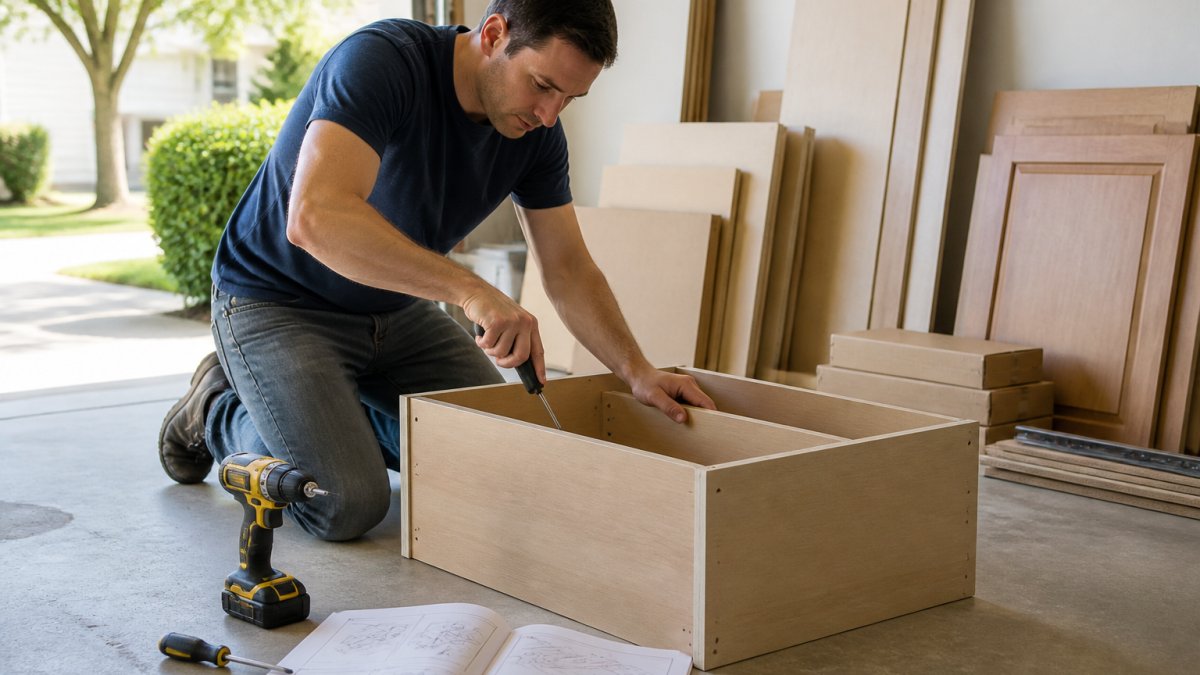
Assembling cabinets needs fewer tools than most people expect. A cordless drill, a screwdriver, a rubber mallet, and a clear floor space cover the vast majority of the work.
Here is what to have on hand before the boxes arrive:
- Cordless drill with a driver bit
- Phillips screwdriver
- Rubber mallet
That is the entire kit for most cabinet lines. You do not need a workshop.
Dover - Sink Base Cabinet W/1 Tilt Outs & Butt Doors →
RTA Cabinet Assembly Time: What to Expect at Every Skill Level
Assembly time for ready to assemble cabinets runs roughly 15 to 45 minutes per cabinet, depending on your experience and the cabinet type. A full kitchen of 15 to 20 boxes is a weekend project, not a month-long one, but the first cabinet always takes longest, and the time per box drops sharply by the third.
| Skill Level | Time per Cabinet | Full Kitchen (15-20 boxes) |
|---|---|---|
| First-timer | 30-45 min | 2-3 weekends |
| Confident DIY | 20-30 min | 1 weekend |
| Contractor | 15-20 min | 1-2 days |
What Changes the Time
Cabinet type matters as much as skill level. A base cabinet with a drawer bank takes longer than a wall cabinet because there are more moving parts to align. A sink base with a tilt-out tray adds a step. A simple wall cabinet is the fastest box in the run.
A realistic sequence for a first-timer:
- Set up a flat, padded work surface.
- Open one box and lay out all parts and hardware.
- Read the instructions once before driving a single screw.
- Assemble the first cabinet slowly, checking square as you go.
- Assemble the rest in batches, repeating the same steps.
Tools You Actually Need
Assembling cabinets needs fewer tools than most people expect. A cordless drill, a screwdriver, a rubber mallet, and clear floor space cover the vast majority of the work.
- Cordless drill with a driver bit
- Phillips screwdriver
- Rubber mallet
That is the entire kit for most cabinet lines. You do not need a workshop.
Common Mistakes That Add Hours
Most lost time comes from a handful of avoidable errors:
- Over-tightening screws. It strips the pilot hole and forces a repair. Snug, not crushed.
- Skipping the glue. Glue plus screws is what makes a box rigid. Screws alone loosen over time.
- Assembling out of square. Check diagonals before the glue sets. A racked box will not hang level.
When to Hire Out Assembly
If your time is billed at a professional rate, or if you have more than about 25 boxes, hiring assembly can be the cheaper path. A handyman who has assembled the same line before will beat a first-timer on every box after the first. The trade-off is simple: pay for speed, or spend the weekend and keep the savings.
Shipping, Damage, and Returns: What Happens If Something Goes Wrong
Flat-pack shipping reduces damage risk, but it does not eliminate it. Inspect every box on delivery, note any visible damage on the carrier's paperwork, and report missing parts before you start assembling.
The reason flat-pack helps is simple: an assembled cabinet is a large, heavy, rigid object that gets dropped and torqued in transit. A flat box flexes and stacks. Fewer things break.
If something arrives broken or missing, the fix is a replacement part, not a full reorder. Report it with photos and your order number as soon as you spot the problem.
Sink Base Cabinet Options for Budget Kitchen Remodels
The sink base is where budget remodels usually spend the most, so it is worth choosing carefully. A sink base has to fit your sink, hide the plumbing, and survive the most moisture in the kitchen.
We stock several sink base configurations, and the right one depends on your sink type and whether you want a tilt-out tray:
| Model | Price | Best For |
|---|---|---|
| Dover Sink Base, 1 Tilt Out & Butt Doors | $663.00 | Adding a tilt-out tray for sponges |
| Dover Sink Base, 2 False Drawers & Center Stile | $671.00 | Farmhouse and apron-front sinks |
| Dover Sink Base, 1 False Drawer & Butt Doors | $546.00 | Standard undermount sinks on a budget |
| US Shaker Sink Base, 2 False Drawers & Butt Doors | $883.00 | Shaker styling with a wider sink opening |
| Petit Sink Base, 2 False Drawers & Butt Doors | $659.00 | Compact kitchens with a clean, simple front |
The center stile model adds a middle support, which matters for heavier farmhouse sinks. The tilt-out version gives you a shallow tray behind the false drawer front, useful for sponges and scrubbers.


If you are unsure which width fits your sink, our free design services can check your layout before you order. That is the step most buyers skip, and it is the one that prevents a costly reorder.
Conclusion
The hard part of a cabinet remodel is not the assembly. It is getting the measurements, the sink base, and the finish right the first time. Frugal Cabinets Online makes that easier with premium ready-to-assemble cabinets, factory-direct pricing, free shipping on orders over $2,500, and fully refundable sample doors with a full kitchen purchase. Our free design services check your layout before you commit.
Frequently Asked Questions
What are ready-to-assemble cabinets?
Ready-to-assemble cabinets, often called RTA cabinets, ship as flat-pack components: cabinet boxes, doors, drawer fronts, and hardware arrive unassembled. You put them together on site using basic tools. This approach cuts shipping volume and warehouse costs, which is why RTA cabinets typically cost less than pre-assembled or custom options. They work well for kitchen remodels, bathroom vanities, and storage projects where you want control over the timeline and budget.
Are ready-to-assemble cabinets good quality?
Quality depends on construction, not on whether the cabinet arrives assembled. Look for solid wood frames, plywood cabinet boxes, and hardware that matches your daily use. At Frugal Cabinets Online, cabinets are built with solid wood frames and sturdy plywood construction, with soft-close functionality on select collections. Request a sample door before ordering a full kitchen so you can inspect the finish, door style, and material firsthand. Refundable sample doors give you a low-risk way to verify quality.
How long does it take to assemble kitchen cabinets?
Assembly time varies by experience and cabinet type. A single base cabinet might take 20 to 40 minutes for a first-timer and 10 to 15 minutes for someone who has assembled a few. A full kitchen of 15 to 20 cabinets could take a weekend for a confident DIYer or several evenings spread across a week. Having the right tools laid out and reading the instructions before you start cuts wasted time significantly.
What tools do you need to assemble RTA cabinets?
Most RTA cabinet assembly requires a cordless drill with a screwdriver bit, a rubber mallet, a tape measure, a level, and a screwdriver. Some collections use cam locks or dowels that need a Phillips head screwdriver. A power drill speeds up the process, but a manual screwdriver works if you are patient. Keep a small container for loose hardware so nothing gets lost during assembly.
How much do ready-to-assemble kitchen cabinets cost?
RTA cabinet pricing depends on size, collection, and door style. At Frugal Cabinets Online, sink base cabinets range from $546 for the Dover 1 False Drawer model to $883 for the US Shaker 2 False Drawer version. The Petit sink base is $659, and the Dover 2 False Drawers with Center Stile is $671. These prices reflect factory-direct pricing, and orders over $2,500 qualify for free shipping. Compare like-for-like sizes when budgeting your full kitchen.

