


Moisture Resistant Materials: Bathroom Vanity Cabinet Guide

Last Updated: November 4, 2026
Quick Summary
Moisture resistant materials for bathroom vanity cabinets are plywood or moisture-resistant MDF for the substrate, paired with a sealed finish such as thermofoil, HPL, or polyurethane. Seal every cut edge and use stainless or coated hardware, because unsealed seams and corroding hinges are where vanities fail first.
- Standard MDF swells permanently when soaked, while moisture-resistant MDF uses a water-repellent resin but is still not waterproof.
- Particleboard is the material most likely to fail in a bathroom, swelling along cut edges and around hinge screws.
- Seal every cut edge on the cabinet box with moisture-resistant sealant or edge banding before assembly.
- Choose 300-series stainless steel hardware and confirm the grade, since lower-grade alloys can still spot in steam.
- A moisture-resistant substrate with sealed edges and corrosion-resistant hardware can serve fifteen to twenty years.
Table of Contents
- Why Moisture Resistant Materials Decide Vanity Lifespan
- Stainless Steel and Thermofoil: Non-Porous Cabinet Options
- MDF vs Plywood for Bathroom Vanity: Which Substrate Holds Up
- Moisture Resistant Cabinet Finishes That Survive High Humidity
- How to Seal Bathroom Vanity Cabinets Against Water Ingress
- Environmental Impact of Synthetic Vanity Materials
- Maintenance Tips That Protect Vanity Surface and Structure
- Choosing Your Vanity Cabinet and Planning the Install
- Frequently Asked Questions
Why Moisture Resistant Materials Decide Vanity Lifespan
Moisture resistant materials for bathroom vanity cabinets are the single biggest factor separating a vanity that lasts fifteen years from one that swells and delaminates in three.
The bathroom is the harshest room in the house for wood products. A single hot shower pushes relative humidity toward saturation, and moist air settles into every cabinet seam, hinge bore, and unfinished edge.
Below, we break down which materials hold up, how to seal a vanity, and the installation habits that prevent water ingress.
Stainless Steel and Thermofoil: Non-Porous Cabinet Options
Stainless steel and thermofoil represent the two extremes of non-porous vanity construction, and both solve the same problem: no exposed wood grain for water to penetrate. Stainless steel is highly resistant to water, which is why it appears in commercial and clinical settings. The trade-off is cost and a cold, industrial look that many homeowners do not want in a primary bath.
Thermofoil and Melamine Benefits for Humid Rooms
Thermofoil is a vinyl film heat-bonded over an MDF core, and melamine is a resin-impregnated paper fused to particleboard. Both create a sealed, wipe-clean surface that shrugs off steam and everyday splashes.
- Non-porous surface resists water absorption at the face
- Easy cleaning with a damp cloth, no refinishing required
- Consistent color that does not fade from steam exposure
- Lower cost than solid wood or stainless steel
Watch out: thermofoil's weakness is its seams. Where the film wraps an edge or meets a corner, water can work underneath and cause the vinyl to peel. Inspect edges at delivery and seal any lift immediately.
MDF vs Plywood for Bathroom Vanity: Which Substrate Holds Up
Plywood is often preferred over MDF in wet applications, but the gap is narrower than plywood's reputation suggests. The real distinction is how each behaves when water reaches it.
Medium-density fiberboard (MDF) is dense, smooth, and takes a finish beautifully. Standard MDF swells when soaked, and once it swells it does not return to shape.
Plywood is built from cross-laminated veneers. That layered structure resists warping and holds its structural integrity better under intermittent damp conditions. Marine-grade and exterior-grade plywood use water-resistant adhesives that hold up to moisture exposure.
Plywood vs Particleboard Stability Under Steam
Particleboard is the material most likely to fail in a bathroom. Its loose internal structure soaks up water quickly, swelling along cut edges and around hinge screws. Plywood's cross-grain construction generally gives it better dimensional stability under steam and holds fasteners more reliably than particleboard.
If you want to see what a moisture-resistant plywood panel actually looks like before you commit, our Weston 3/4 plywood panel with four finished edges shows the construction up close.
Moisture Resistant Cabinet Finishes That Survive High Humidity
The best moisture resistant cabinet finishes share one trait: they form a sealed barrier that keeps water vapor away from the substrate. Finish durability in a bathroom is about blocking water ingress, not just looking good on day one.
Solid Wood, HPL, and Polyurethane Coating Compared
Solid wood offers timeless appeal and can be refinished, but it expands and contracts with humidity.
High-pressure laminate (HPL) bonds a durable decorative layer to the substrate under heat and pressure. It resists moisture well, cleans easily, and stands up to scratches.
Polyurethane coating is a film-forming finish that seals the wood surface against water vapor.
Want to judge a high-gloss finish's humidity performance for yourself? Order a black high gloss sample door and check the surface and edges before you buy a full set.

| Finish | Moisture Resistance | Maintenance | Best For |
|---|---|---|---|
| Thermofoil | High (sealed film) | Wipe clean | Budget humid rooms |
| HPL | High (sealed surface) | Wipe clean | Busy family baths |
| Polyurethane-coated wood | Moderate (film finish) | Occasional recoat | Traditional looks |
| Solid wood, unfinished | Low | Regular sealing | Dry, ventilated baths |
How to Seal Bathroom Vanity Cabinets Against Water Ingress
Sealing a bathroom vanity cabinet decides whether your moisture-resistant materials actually perform. Even a waterproof substrate fails if water reaches an unsealed seam.
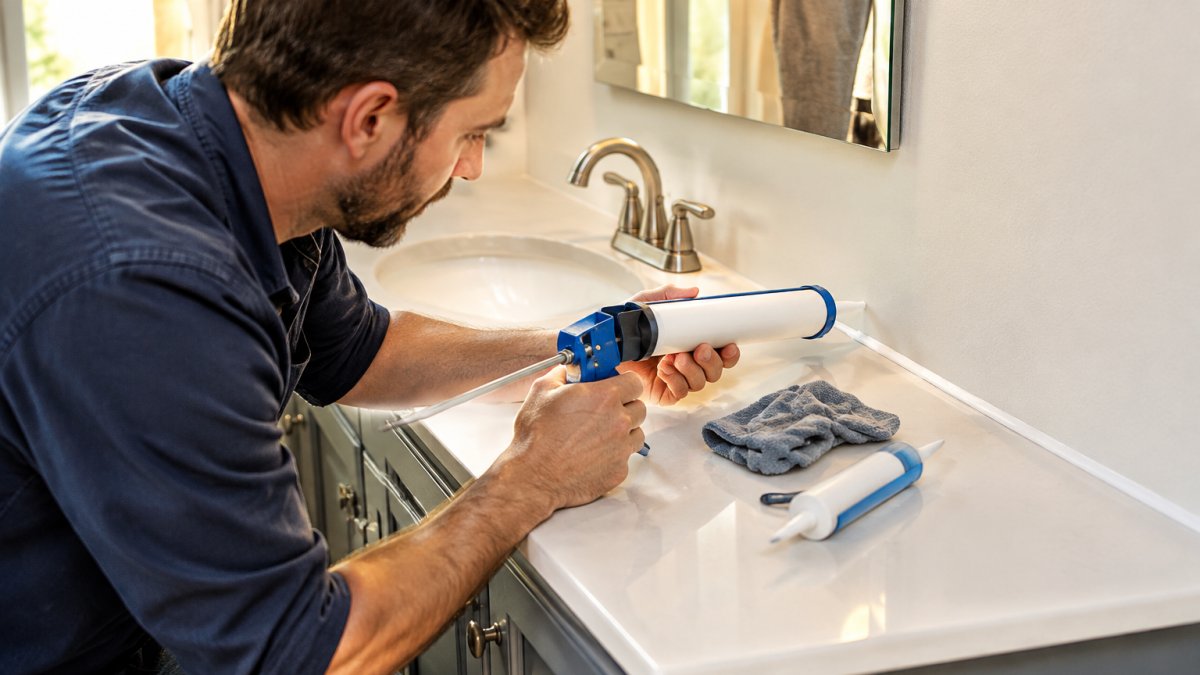
Here is how to seal bathroom vanity cabinets the way we would do it:
- Seal every cut edge on the cabinet box with a moisture-resistant sealant or edge banding before assembly. Cut edges are the most absorbent part of any panel.
- Run a continuous bead of silicone where the vanity meets the wall and the floor, and around the sink cutout.
- Caulk the backsplash seam where it meets the counter and the wall.
- Seal pipe penetrations under the sink with plumber's putty or silicone.
- Recheck annually and refresh any cracked or peeling sealant.
Installation Practices and Hardware Corrosion Protection
Installation best practices start before the vanity goes in. Leave a small gap between the cabinet back and the wall to allow ventilation, and avoid trapping the cabinet tight against a damp exterior wall.
Dover - Vanity Sink Bases 2 Doors W/ 4 Drawers JSI →
Hardware is the most overlooked failure point in a bathroom vanity. The cabinet box can be perfectly sealed, but hinges, drawer slides, and handles take the same steam exposure.
Match the hardware to the room, not just to the door style:
- Stainless steel (300-series) is the default choice for humid baths. Confirm the grade rather than trusting a "stainless" label, because lower-grade alloys can still spot in a steamy room.
- Solid brass and bronze hold up well and develop a patina rather than corroding through. They cost more but are a sound long-term choice for a primary bath.
- Zinc die-cast with a quality powder coat or plated finish is common at lower price points. The coating is the protection, so any chip at a screw hole becomes a corrosion starting point.
- Standard steel with a thin plating is the hardware most likely to fail first. It is fine in a dry kitchen and a poor bet in a wet bath.
Watch out: the screw holes themselves are a corrosion path.
A few installation habits close the remaining gaps:
- Set the vanity on a moisture barrier rather than directly on a damp floor, and keep the cabinet base off standing water.
- Do not over-tighten hinge and slide screws. A crushed screw hole lets water sit against bare substrate.
- Seal the sink cutout rim on the underside of the counter, not just the top edge, so drips from the basin do not reach the cabinet box.
- Confirm the exhaust fan vents outdoors and is sized for the room. A fan that recirculates or is undersized leaves humidity high long after the shower ends.
- Check under the sink after the first month for slow drips at the supply lines and drain, then seasonally after that.
If you want to inspect the hardware and edge details before you commit, our Dover vanity sink base with two doors and four drawers shows how the drawer slides and door hinges are mounted on a moisture-ready build.

Environmental Impact of Synthetic Vanity Materials
Synthetic vanity materials carry a real environmental cost that most buying guides ignore.
Plywood and solid wood score better environmentally, especially when sourced from responsibly managed forests and finished with low-VOC coatings.
The practical problem is that "eco-friendly" is a marketing word until you tie it to a specification.
Start with the wood fiber source. Forest certification is the clearest signal that the plywood or solid wood came from responsibly managed forests.
Treat longevity as the largest environmental lever. The greenest vanity is the one you do not replace.
Watch out: a "green" label on the finish says nothing about the panel underneath.
A short buying checklist for a more sustainable, moisture-ready vanity:
- Certified wood fiber with documented chain of custody
- Low-emission composite core meeting a recognized formaldehyde limit
- Low-VOC or waterborne finish on all six sides of doors and panels
- Sealed cut edges so the panel does not need early replacement
- Corrosion-resistant hardware so the vanity is not scrapped for a failed hinge
Maintenance Tips That Protect Vanity Surface and Structure
Maintenance is where moisture resistance either holds or quietly erodes. A few habits keep the surface protection and structural integrity intact:
- Wipe up standing water on the counter and in the cabinet within minutes, not hours.
- Run the exhaust fan during and after every shower to control high humidity.
- Inspect sealant around the sink and backsplash every few months and touch up cracks.
- Keep the cabinet interior dry, and check under the sink for slow leaks that cause mold and swelling.
- Avoid soaking the surface when cleaning; a damp cloth beats a wet sponge every time.
Choosing Your Vanity Cabinet and Planning the Install
Choosing a vanity cabinet comes down to matching the substrate and finish to your bathroom's humidity, then planning the install so water never reaches an unfinished edge. A plywood cabinet box with a sealed finish and stainless hardware is the combination that survives real-world bathroom conditions.
Frugal Cabinets Online's ready-to-assemble vanities are built with solid wood frames and sturdy plywood construction. If you are ready to pick a sink base, our Dover vanity sink base with two doors and four drawers gives you drawer storage with a moisture-ready build, and our FC Shaker vanity base with one door and one drawer suits a smaller bath. Before you order, read our guide on how to choose RTA vanity cabinets for safe delivery so your cabinets arrive intact and your timeline holds.

Frequently Asked Questions
What is the best waterproof material for bathroom cabinets?
No wood-based cabinet is fully waterproof, but plywood with a moisture-resistant finish and sealed edges comes closest for a vanity box. Plywood holds screws better and resists swelling longer than particleboard when water gets in. For the most humid spots, non-porous options like thermofoil over MDF or stainless steel avoid the swelling problem entirely. Whichever moisture resistant materials you pick, seal the cut edges and around the sink opening, since that is where water ingress starts.
Is MDF or plywood better for a bathroom vanity?
Plywood generally wins in a bathroom because its cross-grain layers resist warping and hold fasteners through repeated humidity cycles. Standard MDF swells and crumbles once water reaches its core, though moisture-resistant MDF grades perform better. If you choose MDF, keep every edge and seam sealed and fix leaks fast.
How do I protect my bathroom vanity from water damage?
Seal all seams where the cabinet meets walls, floors, and the sink with a silicone sealant rated for bathrooms, and reapply it when it cracks. Wipe up standing water promptly, run the exhaust fan during showers to cut high humidity, and check under the sink monthly for slow leaks. A polyurethane coating on exposed wood edges adds surface protection. These habits extend finish durability and prevent the swelling and delamination that shorten vanity life.
Are solid wood cabinets good for bathrooms?
Solid wood works in bathrooms when the finish stays intact, but it expands and contracts with humidity changes, which can open joints over time. It resists water better than particleboard but less predictably than plywood or thermofoil. Solid wood frames paired with plywood cabinet boxes, like the Dover vanity sink bases, balance durability with a traditional look. Keep the finish sealed and control ventilation, and solid wood holds up well in most bathrooms.
The bathroom will always be humid. The question is whether your vanity was built to handle it. Frugal Cabinets Online makes that decision easier with plywood-construction RTA cabinets, free design services to plan your layout, and fully refundable sample doors so you can check the finish before you commit. Get started with Frugal Cabinets Online and build a vanity that outlasts the steam.


