


How Durable Are RTA Kitchen Cabinets: A 2026 Guide

Table of Contents
- What Ready-to-Assemble Kitchen Cabinets Are and Why Durability Matters
- How Long Do RTA Cabinets Last: Expected Lifespan and Service Life
- RTA Cabinet Quality: Materials That Define Durability
- Plywood vs. Particleboard Cabinets: Which Lasts Longer
- Assembly, Installation, and Real-World Durability
- How to Maintain Kitchen Cabinets for Maximum Lifespan
- RTA vs. Pre-Assembled Cabinets: Durability Comparison
- Warranty Coverage and What It Reveals About Expected Service Life
- Frequently Asked Questions
Last Updated: October 14, 2026
What Ready-to-Assemble Kitchen Cabinets Are and Why Durability Matters
Ready-to-assemble kitchen cabinets, or RTA cabinets, arrive flat-packed with all components cut and ready to assemble.
Durability depends on three factors: construction materials, assembly and installation quality, and maintenance. Many homeowners assume RTA cabinets are flimsy compared to pre-assembled options, but the real difference lies in construction specifications, not the assembly method.
RTA cabinets cost less because you're paying for materials and engineering, not factory labor and shipping weight. That savings can be reinvested into better materials and hardware, directly impacting longevity.
How Long Do RTA Cabinets Last: Expected Lifespan and Service Life
Most quality RTA kitchen cabinets last between 15 and 25 years with proper care and installation.
Where the 20-30-Year Estimate Actually Comes From
The commonly quoted 20-30-year lifespan is inferred from overlapping sources:
- Material service-life expectations. Manufacturers of plywood, MDF, and particleboard publish durability guidance for interior applications, and cabinet lifespans are extrapolated from those rather than cabinet-specific testing.
- Warranty and replacement cycles. Remodeling data on how often kitchens are renovated, roughly every 20 years, gets folded into lifespan claims, even though renovation cycles reflect changing taste as much as physical failure.
- Practitioner experience. Contractors report that well-built plywood cabinets routinely remain functional for two to three decades.
The 20-30-year figure is a reasonable planning assumption, not a guarantee, useful for budgeting, but dependent on how the product is used.
Estimate vs. Measured Product Life
There's an important distinction between an expected lifespan and a measured one. Measured product life comes from accelerated aging, moisture-cycling, and load testing, data you sometimes see for appliances or flooring. Cabinet manufacturers rarely publish this.
Read estimates as conditional: this is how long cabinets tend to last when materials, assembly, installation, and environment all cooperate. Change any variable and the number moves.
What Actually Shortens or Extends Service Life
Rather than fixating on a single number, focus on the variables that push a cabinet toward the low or high end:
- Box material. Plywood boxes tend to reach the upper end of the range.
- Joinery. Pocket-hole, dowel, and dovetail joints hold up far better than stapled or glued-only construction.
- Hardware. Hinges and slides are usually the first components to wear out, often well before the box does.
Which Components Fail First
To gauge how long your cabinets will last, watch the components that fail earliest:
- Drawer slides, the first thing to loosen, sag, or stop gliding smoothly under heavy loads.
- Hinges, especially on doors opened dozens of times a day.
- Door and drawer fronts, finishes chip, edges wear, and veneers can delaminate near moisture.
- Shelves, particleboard shelves sag under load; plywood shelves resist it.
- Cabinet box joints, the last thing to fail in a well-built cabinet, and the first in a poorly built one.
This order helps you decide where to spend money. Upgrading slides and hinges is inexpensive and significantly extends useful life; upgrading the box only matters if the box is the weak link.
Environmental Factors That Move the Number
High humidity, temperature swings, or water exposure accelerate wear on finishes and joints. A cabinet next to a dishwasher or sink faces a very different challenge than one across the room. Proper ventilation and moisture management can add years to cabinet life; ignoring them subtracts them.
RTA Cabinet Quality: Materials That Define Durability
Cabinet Box Construction
The cabinet box is the foundation of durability. A solid plywood box supports weight, resists warping, and maintains structural integrity far longer than particleboard.

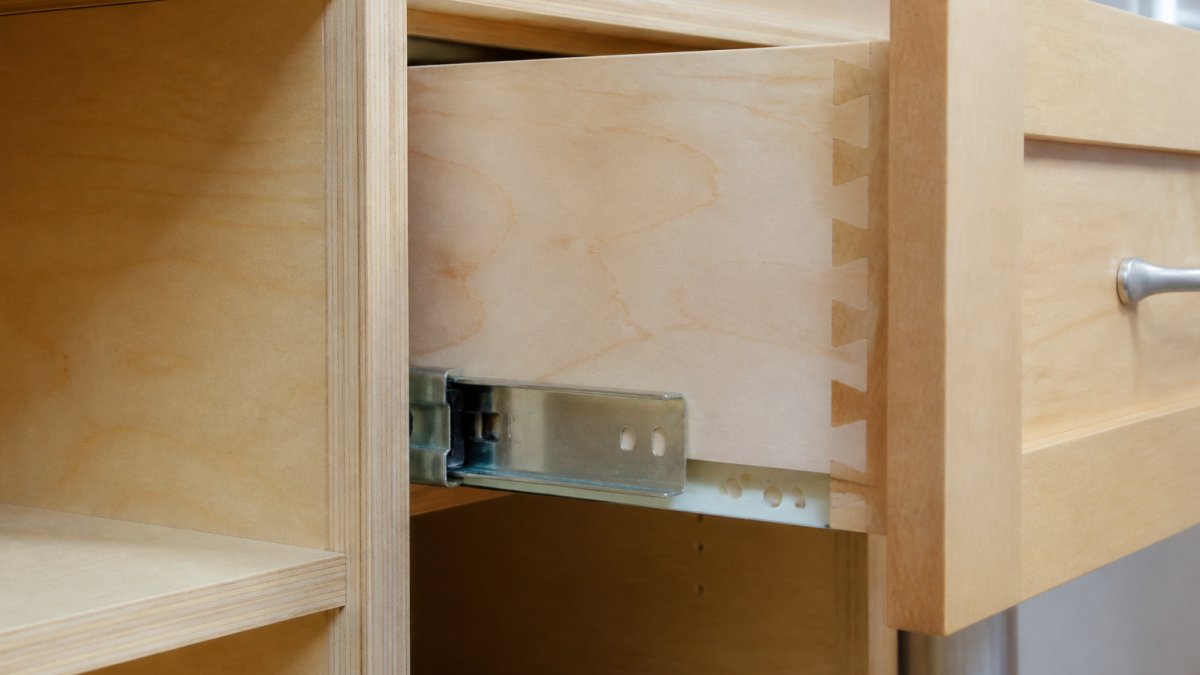
Frugal Cabinets Online uses solid wood frames with sturdy plywood cabinet boxes.

Box thickness matters too. Checking box material and thickness should be your first step when evaluating RTA cabinets.
Joinery quality separates durable cabinets from disposable ones.
Doors, Drawers, and Hardware
Cabinet doors face constant stress from opening, closing, and temperature changes. Solid wood or plywood doors last significantly longer than hollow-core or veneered particleboard doors.
Drawer construction affects how long cabinets feel solid.
Hardware quality, hinges, slides, and handles, determines whether doors and drawers operate smoothly after five years or feel worn. Soft-close hinges and slides reduce stress on hardware and the box itself.
Plywood vs. Particleboard Cabinets: Which Lasts Longer
Plywood cabinet boxes maintain structural integrity for 20-30 years in typical conditions.
The difference is material stability. Plywood's cross-grain construction resists moisture and maintains its shape.
Cost is the trade-off. Particleboard cabinets cost less upfront.
| Material | Typical Lifespan | Moisture Resistance | Best For | Long-Term Cost |
|---|---|---|---|---|
| Plywood | 20-30 years | Excellent | Durable kitchens, humid areas | Lower per-year cost |
| Particleboard | 10-15 years | Poor | Budget renovations, dry climates | Higher per-year cost |
| MDF | 12-18 years | Fair | Painted finishes, moderate use | Moderate per-year cost |
Frugal Cabinets Online prioritizes plywood construction to deliver durability at affordable prices, you're paying for materials that last, not premium labor.
Assembly, Installation, and Real-World Durability
A well-made cabinet assembled incorrectly fails faster than a quality build.
Common assembly mistakes include over-tightening screws (stripping wood fibers) and under-tightening (loose joints). Checking for square, using appropriate hardware, and not forcing parts together directly extends cabinet life.
Installation errors create problems assembly quality can't fix. Cabinets not anchored to wall studs rack and twist under load; those installed on uneven floors without shimming develop joint stress.
Moisture control during and after installation matters.
How to Maintain Kitchen Cabinets for Maximum Lifespan
Maintenance is the most underrated factor in cabinet durability, simple practices can extend cabinet life by 5-10 years.
Wipe spills immediately, especially near sinks and dishwashers, standing water seeps into joints and finishes, causing swelling and delamination.
Check soft-close hinges and slides annually, catching wear early prevents damage to cabinet boxes.
Maintain proper ventilation: run exhaust fans while cooking and for 20 minutes after to reduce humidity that ages finishes and weakens wood.
For cabinets with painted finishes, touch-ups prevent small damage from becoming visible wear. Frugal Cabinets Online offers a Dover Touch Up Kit designed to match our cabinet finishes, making repairs simple and invisible.

RTA vs. Pre-Assembled Cabinets: Durability Comparison
The durability difference between RTA and pre-assembled cabinets is smaller than most people assume, both depend on material quality and construction methods.
Pre-assembled cabinets cost more because you pay for factory assembly labor and shipping weight, but that extra cost doesn't necessarily translate to better durability.
The real advantage of pre-assembled cabinets is convenience and reduced assembly risk.
RTA cabinets offer one durability advantage: customization.
| Aspect | RTA Cabinets | Pre-Assembled Cabinets |
|---|---|---|
| Material quality | Varies widely | Varies widely |
| Assembly risk | Higher if DIY | Eliminated |
| Customization | Excellent | Limited |
| Cost | Lower | Higher |
| Durability potential | Same as pre-assembled | Same as RTA |
Warranty Coverage and What It Reveals About Expected Service Life
Warranty terms are one of the few places a manufacturer puts its durability confidence in writing. Read carefully, they reveal more about expected service life than most marketing copy, if you know what to look for.
What a Warranty Length Actually Signals
A warranty isn't a lifespan guarantee, but its length and structure track with how long the manufacturer expects the product to remain serviceable:
- 1-year coverage, signals a budget product where failures are expected to surface quickly if at all.
- 5-year coverage, a middle-ground signal, common on hardware and cabinets where the box outlasts attached components.
- Limited lifetime coverage on the box, indicates confidence the structure won't fail under normal use, though "lifetime" usually means the original purchaser's ownership, not an actual human lifetime.
The Exclusions That Matter Most
Nearly every cabinet warranty excludes the same damage categories, and those exclusions map onto the durability risks you manage:
- Improper installation or assembly. Failures from cabinets not anchored to studs, not shimmed level, or assembled with wrong fasteners are on you, not the manufacturer.
- Moisture and water damage. Swelling, delamination, and finish failure from leaks, spills, or humidity are almost universally excluded, even on well-built cabinets.
- Normal wear and tear. Fading, minor scratches, and gradual hardware loosening typically aren't covered.
How to Read a Warranty Before You Buy
When comparing RTA cabinets, use the warranty as secondary confirmation of quality, not the primary decision factor. A short checklist:
- What is the coverage period for the box, doors, drawers, and hardware separately? Components usually carry different terms, and hardware is often shortest.
- What is excluded? Look for moisture, improper installation, and commercial use.
- Who pays shipping on a replacement? Some warranties cover the part but not delivery.
- What proof of purchase and installation is required? Some manufacturers require documentation of professional installation.
- Is the warranty transferable? Most aren't, which matters if you plan to sell.
What Warranty Terms Reveal About Durability
A limited lifetime warranty on the box paired with a shorter hardware warranty reflects a realistic durability model: the box lasts decades while hinges and slides wear out and get replaced, exactly what happens in real kitchens.
When comparing RTA cabinets, warranty terms matter less than material specifications and construction details. Focus on materials and joinery first, then use warranty terms as secondary confirmation.
Frequently Asked Questions
How long do RTA cabinets last with proper care?
RTA cabinets typically last 15 to 30 years, depending on materials, assembly quality, and maintenance. Cabinets built with plywood box construction and solid wood frames generally reach the higher end of this range. Proper installation, regular cleaning, and moisture control are critical to achieving maximum lifespan.
Are RTA cabinet quality and durability affected by assembly mistakes?
Yes, assembly errors significantly impact durability. Loose joints and improperly installed soft-close hinges can cause premature failure, warping, and sagging. Poor assembly also creates gaps where moisture enters, leading to swelling and deterioration. Careful assembly, using all provided hardware, and following instructions precisely are essential to ensure cabinets perform as designed and last their full service life.
Is plywood better than particleboard for RTA kitchen cabinets?
Plywood is generally more durable than particleboard or MDF for cabinet boxes. Plywood resists moisture, warping, and weight stress better than particleboard. For cabinets expected to last 20+ years, plywood construction is the more reliable choice.
How do I maintain RTA kitchen cabinets to extend their lifespan?
Clean cabinet surfaces regularly with a soft, damp cloth and mild soap; avoid excessive water and harsh chemicals. Wipe up spills immediately to prevent moisture absorption. Ensure proper ventilation and humidity control to prevent swelling and warping. Check hinges and drawer slides periodically and tighten loose hardware. Use touch-up kits for minor scratches or finish damage. Avoid overloading shelves beyond weight capacity, which can cause sagging and joint failure.
Do RTA cabinets hold up to moisture and everyday wear better than pre-assembled options?
RTA and pre-assembled cabinets have comparable durability if made from the same materials and properly assembled. The difference lies in construction quality, not assembly method. RTA cabinets with plywood boxes, soft-close hardware, and solid wood frames perform as well as pre-assembled equivalents. The key advantage of RTA is cost savings without sacrificing durability when you choose quality materials and assemble correctly.
What warranty terms should I look for to understand RTA cabinet durability?
Warranty length often reflects manufacturer confidence in durability. Look for warranties covering cabinet boxes, doors, drawers, and hardware separately. Warranty terms that exclude water damage or improper installation reveal expected failure modes. Review what is and isn't covered.
What causes RTA cabinets to fail prematurely?
Common failure modes include moisture exposure (swelling, warping, joint failure), poor assembly (loose joints), overloading shelves (sagging, hardware stress), and low-quality materials (particleboard degradation, cheap hinges). Humidity fluctuations, proximity to sinks or dishwashers, and lack of maintenance accelerate wear. Choosing plywood construction, soft-close hardware, and proper installation prevents most premature failures. Touch-up kits and replacement parts can extend life when minor damage occurs.

