


Best Floating Vanity Base Cabinets for Modern Bathrooms

Last Updated: November 6, 2026
Quick Summary
A floating vanity is a wall-hung cabinet that leaves the floor visible underneath, which makes small bathrooms feel larger and easier to clean. The best choice depends on the width you can fit, the drawer layout you need, and whether the wall can carry the cabinet's weight when fully loaded.
- Measure wall width and plumbing clearance before choosing a cabinet size.
- Confirm the wall can take the cabinet's weight once it holds items.
- Anchor the cabinet into studs using the manufacturer's specified fasteners.
- Two drawers suit most users; a single wide drawer holds bulkier items.
- Confirm the top and sink match the cabinet's width and mounting points before ordering.
Table of Contents
- Why Floating Vanity Base Cabinets Suit Modern Bathrooms
- What to Check Before Buying a Floating Vanity Base
- Floating Bathroom Vanity Cabinet Only: Buying Without a Top
- Comparing the Best Floating Vanity Base Cabinets
- Floating Bathroom Vanity 30 Inch: Sizing for Small and Mid-Size Baths
- Wall-Mounted Bathroom Vanity Installation: Studs, Weight and Cost
- Choose Your Floating Vanity Base and Plan the Install
- Frequently Asked Questions
Floating vanity base cabinets have moved from a niche design choice to a standard request in modern bathroom remodels. Homeowners often want more open floor space, easier cleaning, and a cleaner look. The right floating vanity base can deliver all three, but only if the cabinet is sized, built, and mounted correctly for the bathroom it goes into.
This guide walks through floating vanity base options from the Frugal Cabinets Online catalog, what to check before you buy, and how to plan the installation. We cover sizing, cabinet-only buying, and wall-mounting considerations.
Why Floating Vanity Base Cabinets Suit Modern Bathrooms
A floating vanity base is a cabinet that hangs on the wall instead of sitting on the floor. Because the bottom of the cabinet sits above the floor, the floor stays visible underneath. That open space makes a small bathroom feel larger and lets you clean the floor without moving anything.
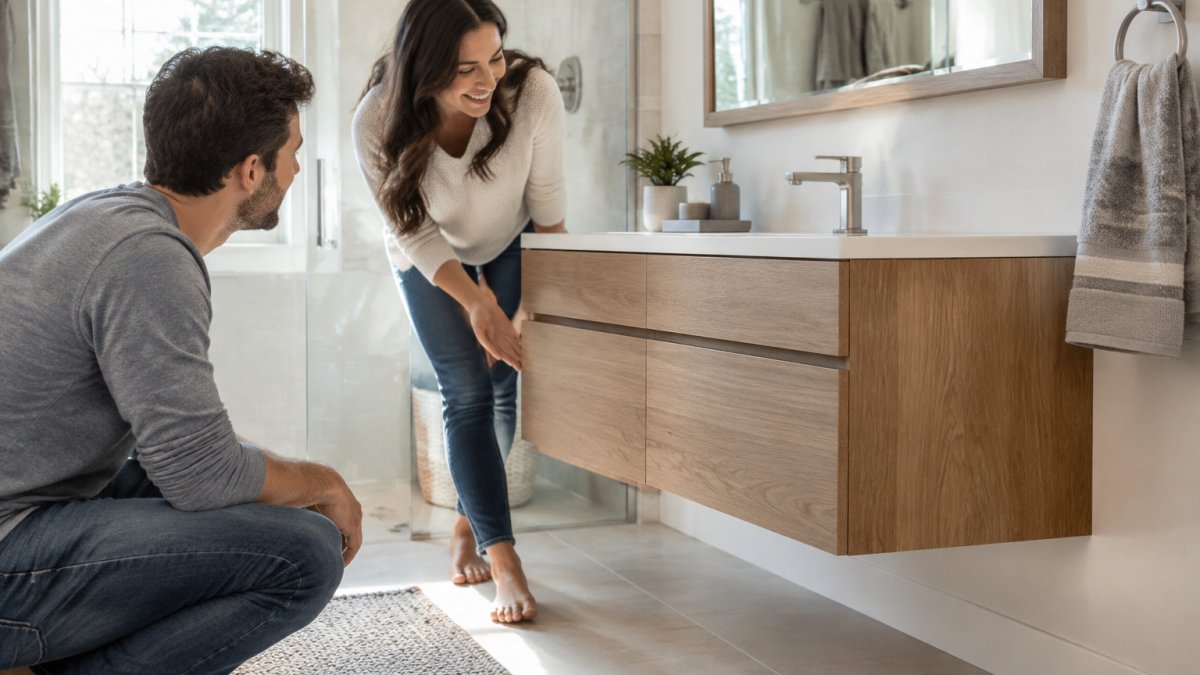
Floating designs also suit contemporary styling. They pair well with wood finishes, flat-front doors, and slim pulls. Many homeowners pick them for the clean, lightweight look that a freestanding cabinet cannot provide.
The trade-off is structure. A wall-hung cabinet depends on solid mounting into studs or a reinforced wall. We cover that in detail later in this guide.
What to Check Before Buying a Floating Vanity Base
Before you pick a cabinet, confirm five things:
- Width: Measure the wall space between obstructions and leave room for plumbing clearance.
- Depth: Check that the cabinet clears the door swing and the toilet, if they share the wall.
- Drawer layout: Two drawers suit most users. A single wide drawer can hold more bulky items.
- Mounting method: Confirm that the wall can take the cabinet's weight once it holds items.
- Finish and style: Match the finish to your flooring, tile, and fixtures.
Most buyers skip the mounting check. Do not. A cabinet that fits the wall visually but cannot be anchored properly will fail under load.
Floating Bathroom Vanity Cabinet Only: Buying Without a Top
Many buyers want the cabinet without a countertop. That is a reasonable choice when you plan to fit a stone top, a custom top, or a specific sink later. It also lets you control the total cost, since tops can add a large share of the price. Buying cabinet-only is a different purchase, and it has its own checklist.
Confirm the cabinet is actually cabinet-only
Before you order, read the product title and specifications carefully. Check the included-items list to confirm whether a top or sink is part of the purchase, and ask before you buy if anything is unclear.
Match the top to the cabinet, not the other way around
When you buy the cabinet only, confirm that the base and the top match in width and mounting points. Measure the cabinet's exact dimensions before you order a top. A top that is even half an inch off will not sit flush. Check three dimensions in particular:
- Width: The top should match the cabinet's outside width or overhang by the amount the manufacturer specifies. A top narrower than the cabinet leaves the cabinet edges exposed.
- Depth: Confirm the top depth clears the backsplash and the sink cutout. A deeper top can interfere with the wall or the faucet placement.
- Sink cutout: If you are adding a sink, confirm the cutout size and center placement match the cabinet's drawer layout. A cutout that lands over a drawer bank can block the top drawer.
Also confirm the mounting points. Some tops attach through the cabinet's top rail, and some cabinets are designed for a top that sits on a specific cleat. If the cabinet has a finished top edge, the top may be designed to sit inside a lip rather than overhang.
Plan the plumbing and sink before the top arrives
A cabinet-only purchase gives you freedom, but it also moves the plumbing decisions to you. Decide whether the sink will be undermount or drop-in, because the cutout and the cabinet's interior clearance differ. Undermount sinks need a solid top and often a slightly deeper cabinet interior. Drop-in sinks are more forgiving and easier to replace later. Confirm that the cabinet's back panel and drawer boxes leave room for the drain and supply lines, especially in a two-drawer base where the top drawer may sit close to the sink.
Weigh the cost trade-off
The cost of a cabinet-only base depends on the top and sink you choose. Add the cabinet price, the top price, the sink price, and any fabrication or installation labor before you compare the total against a complete vanity set.
Comparing the Best Floating Vanity Base Cabinets
The following options come from the Frugal Cabinets Online catalog. Prices are listed in USD.
| Cabinet | Starting Price | Drawers / Doors | Best For |
|---|---|---|---|
| Venice Vanity 3-Drawer Base | $690.55 | 3 drawers | Maximum drawer storage |
| Venice Hanging Vanity Sink Base with 2 Drawers | $695.95 | 2 drawers | Sink-centered storage |
| Venice Vanity Floating 2-Drawer Base | $594.00 | 2 drawers | Clean floating look |
| Trends Vanity Floating 2-Drawer Base | $579.00 | 2 drawers | Budget floating option |
| Alvic Vanity Floating 2-Drawer Base | $594.00 | 2 drawers | Balanced price and layout |
| Venice Hanging Vanity Sink Base with 2 Doors | $436.00 | 2 doors | Lower-cost door storage |
| Venice Vanity Base Full Height Door | $230.78 | 1 door | Small utility cabinet |
Venice Hanging Vanity Sink Base with 2 Drawers
This is a sink-centered base built around the sink. It keeps everyday essentials within reach while staying off the floor. At $695.95, it is one of the higher-priced options in the lineup, so it suits buyers who want two drawers and a sink-focused layout.
Venice Vanity Floating 2-Drawer Base
At $594.00, this floating base gives a clean, open look with two drawers for daily items. It is a practical choice for a single-sink bathroom where you want a lighter visual footprint.
Venice Hanging Vanity Sink Base with 2 Drawers →

Trends and Alvic Floating 2-Drawer Bases
The Trends floating 2-drawer base starts at $579.00, and the Alvic floating 2-drawer base starts at $594.00. Both share the two-drawer floating layout. Compare the finish and dimensions on each product page before you choose between them.

Floating Bathroom Vanity 30 Inch: Sizing for Small and Mid-Size Baths
A 30-inch width suits many small and mid-size bathrooms. It fits most standard powder rooms and leaves room for a toilet or door clearance in tighter layouts. Measure the wall first, then subtract the space you need for plumbing and clearance.
Wall-Mounted Bathroom Vanity Installation: Studs, Weight and Cost
A floating vanity has to carry its own weight plus everything stored inside it, and that load transfers entirely to the wall. Most installations anchor the cabinet to wall studs using heavy-duty mounting rails or brackets. Find the studs with a stud finder, mark them, and confirm the locations before drilling.
Wall structure and load capacity
A wall-hung cabinet depends on framing, not drywall. Wall studs are commonly spaced at 16 or 24 inches on center, and steel studs need different fasteners. Confirm the stud spacing before you order a cabinet, because the mounting points on the cabinet back must line up with framing or with added blocking.
Fasteners matter as much as framing. Follow the cabinet manufacturer's fastener specification, since the rail and bolt size vary by product.
Estimating the load
Check the manufacturer's stated weight capacity for the cabinet and stay under it, accounting for the weight of items you plan to store.
Watch out: a cabinet that fits the wall visually but cannot be anchored into framing will pull loose under load, and the failure usually happens at the top rail where the fasteners sit.
Moisture and material durability
Bathrooms are humid, and a floating cabinet has no floor contact to wick water, but the back panel and the area around the sink still see splashes and steam. Compare cabinet materials before you buy:
- Plywood: Resists moisture better than particleboard and holds screws well. Common in mid- and upper-tier cabinets.
- MDF: Dense and smooth for painted finishes, but it swells when water reaches the core. Seal cut edges and keep the back panel dry.
- Particleboard: The most moisture-sensitive common substrate. It works in dry zones but is a poor choice near a shower or a frequently splashed sink.
- Solid wood: Durable and repairable, but it moves with humidity and needs a finish that seals all faces.
Choose finishes and sealed materials built for wet areas, and keep the cabinet sealed around the sink to prevent water from reaching the back panel. A cabinet with a sealed back panel and edge-banded shelves will hold up better over time than an unsealed one, regardless of the core material.
Installation cost and difficulty
Installation can be a manageable DIY job if the wall is solid and the studs line up. If the wall needs reinforcement or the plumbing has to move, consider hiring a qualified professional for that work.
Plan the mounting before the cabinet arrives. Good anchoring matters more than any other step in the install.
Choose Your Floating Vanity Base and Plan the Install
Start with your measurements. Confirm the wall width, the stud locations, and the plumbing clearance. Then choose the base that fits your storage needs and budget, from the $579.00 Trends floating base to the $690.55 three-drawer Venice option.
If you plan to buy the cabinet without a top, order the top after you confirm the cabinet's exact dimensions. Keep the mounting hardware with the cabinet, and read the install instructions before you start drilling.
Frequently Asked Questions
What should I look for in a floating bathroom vanity base cabinet?
Start with the wall structure, because a floating vanity has to carry its weight through mounting hardware anchored into wall studs or a reinforced wall. Check the cabinet's construction and whether it is fully assembled, then confirm the drawer layout, since drawers and soft-close slides determine how much of the storage you can actually reach. Verify the width and depth against your plumbing clearance before you order. Finally, look at finish and moisture resistance, because a bathroom humidity level will test the cabinet surface every day.
What size floating vanity is best for a small bathroom?
A 30-inch floating vanity is a common choice for small bathrooms because it keeps some floor space open while still giving you drawer storage. Measure the room and the path to the toilet and door first, then confirm the cabinet depth leaves enough clearance for the knees and the door swing. A shallower cabinet depth often gives more open floor space, which matters most in tight layouts.
Can I buy a floating bathroom vanity cabinet without a top?
Yes. A floating bathroom vanity cabinet only, sold without a top, lets you choose your own countertop and sink so the finished vanity matches your design. Make sure the cabinet width and mounting points match the top you plan to use, and confirm the sink cutout and plumbing location before ordering. Buying the base alone also means you can compare countertop materials separately.
Do floating vanities need wall studs or extra support?
Most floating vanities need solid anchoring into wall studs or a reinforced wall, because the cabinet hangs from the wall and carries the weight of the sink and contents. Check the manufacturer's weight guidance and use the mounting hardware provided, rather than relying on drywall alone. If you are unsure about the wall structure, a licensed installer can assess it and handle the mounting.
Ready to plan your bathroom? Browse the floating vanity bases in the Frugal Cabinets Online catalog, compare the dimensions, and pick the layout that suits your space.


