


Benefits of Installing Soft Close Waste Containers

Last Updated: November 4, 2026
Quick Summary
Soft close waste containers are pull-out trash systems with damped hinges or slides that draw the bin shut gently instead of letting it slam. Installing them makes your kitchen quieter, hides waste out of sight, frees up floor space, and reduces cabinet wear and pinch risk.
- A pull-out waste container stacks trash, recycling and often a liner drawer in one cabinet footprint.
- Damped slides catch the last few inches and guide the unit home, so the bin cannot slam.
- An under-sink garbage pull-out belongs in the base cabinet next to the sink for one-motion scraping and rinsing.
- Measure interior width, depth, height, door overlay style and counter overhang distance before buying.
- Frugal Cabinets Online offers free design services, flat 50% off premium cabinets and free shipping over $2,500.
Table of Contents
- Why Soft Close Waste Containers Change How Your Kitchen Works
- Space-Saving Cabinet Storage That Frees Up Floor Space
- Keeping Trash Out of Sight for a Cleaner Kitchen Appearance
- How a Kitchen Cabinet Garbage Pull-Out Improves Daily Convenience
- Soft-Close Trash Pull-Out vs. Standard Pull-Out: What Actually Differs
- Where an Under-Sink Garbage Pull-Out Fits Best in Your Layout
- Choosing a Soft Close Waste Container That Fits Your Cabinet
- Plan Your Pull-Out Waste Container With Frugal Cabinets Online
- Frequently Asked Questions
Why Soft Close Waste Containers Change How Your Kitchen Works
Soft close waste containers are pull-out trash systems with damped hinges or slides that draw the bin shut gently instead of letting it slam. A kitchen with a soft close waste container often feels quieter, tidier, and easier to keep clean after a small remodel. A trash bin that glides back into place removes one daily annoyance you probably stopped noticing years ago.
The benefits of installing soft close waste containers reach further than the closing action itself. They change where waste lives, how often you bend and reach, and how much wear your cabinet boxes take over a decade of daily use. Below, we break down each benefit in order, then show you how to size a unit to your actual cabinet opening so you buy once and install it correctly.
Space-Saving Cabinet Storage That Frees Up Floor Space
A freestanding trash can occupies floor space in the busiest room in the house. Moving waste into a base cabinet reclaims that footprint for a stool, a pet bowl, or simply clear walking room. The same principle applies across the kitchen: soft close rollout trays turn deep, dark cabinet interiors into usable storage, so you gain capacity without adding a single square foot.

Space-saving storage is really about consolidation. A pull-out waste container stacks trash, recycling, and often a liner drawer in one footprint inside the cabinet. Fewer freestanding objects means less to trip over and less to wipe around. If you are working with a narrow galley or a compact layout, this is the single highest-value change you can make to a base cabinet.
Keeping Trash Out of Sight for a Cleaner Kitchen Appearance
Concealed waste is the benefit guests actually notice. A closed cabinet door hides the bin, the bag edges, and the crumbs that collect around a freestanding can. The kitchen reads cleaner because the visual clutter is gone, not because you cleaned more.
There is a practical side too. A lidded bin inside a cabinet limits how easily flies and gnats reach food waste, and it keeps odors contained until you pull the handle. The result is a kitchen that looks intentional rather than improvised.
How a Kitchen Cabinet Garbage Pull-Out Improves Daily Convenience
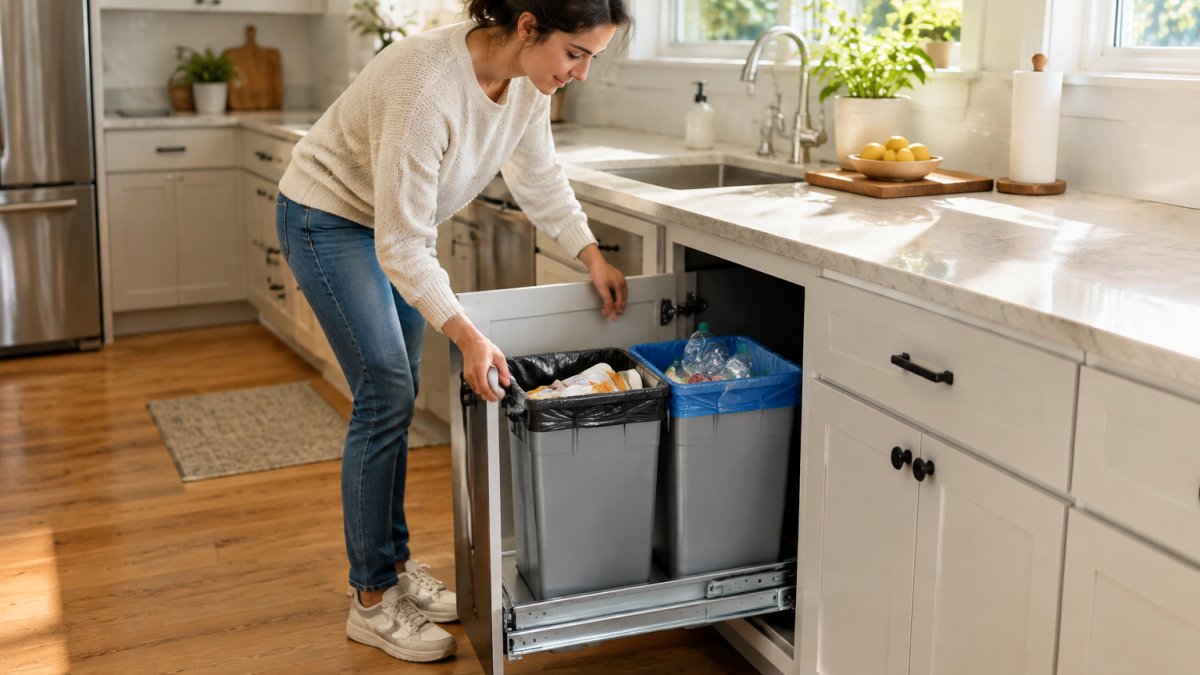
Convenience comes down to reach. A kitchen cabinet garbage pull-out brings the bin opening to counter height with one hand, so you can scrape a plate without bending or stepping across the room. That matters most during meal prep, when you make a dozen small trips to the trash in twenty minutes.
A double-bin configuration adds a second gain: sorting becomes automatic. Trash goes in one bin, recycling in the other, and you never carry a dripping container across the floor. If you want the cabinet and the pull-out in one purchase, our Yarmouth Slab base cabinet with a soft close trash pull-out arrives ready to install with the bin and drawer already configured. For most families, this is the point where the upgrade pays for itself in daily effort saved.

Soft-Close Trash Pull-Out vs. Standard Pull-Out: What Actually Differs
The difference is the closing mechanism, not the layout. A standard pull-out rolls on plain slides and closes at whatever speed you push it. A soft-close trash pull-out uses damped slides or hinges that catch the last few inches and guide the unit home.
That single change produces several effects at once:
- Controlled closing. The bin cannot slam, even when you push it hard with a full bag.
- Noise reduction. No bang when the drawer meets the cabinet face.
- Less cabinet wear. Repeated impact loosens fasteners and stresses the cabinet floor over time; damped closing removes that shock.
- Reduced pinch risk. The unit cannot snap shut on fingers, which matters in busy households with children.
A slam sends force straight into the slides and the cabinet box, while soft-close hardware spreads that force over a longer travel. You can see the hardware on our steel bottom mount 50 qt double waste container with soft close.
Where an Under-Sink Garbage Pull-Out Fits Best in Your Layout
An under-sink garbage pull-out belongs in the base cabinet next to the sink, where you scrape and rinse in one motion. For layouts where the sink base is tight, dedicated sink base storage solutions are built around the drain and supply lines rather than fighting them.

Placement rules we would follow:
- Keep the bin within one step of the prep zone and the dishwasher.
- Avoid a corner cabinet unless the pull-out is designed for it; the door swing gets in the way.
- Check that the cabinet opening clears the bin height plus the slide, especially in a reduced-depth cabinet.
- Leave room for the door attachment or door-mount hardware if you want the cabinet face to ride out with the bin.
Plumbing clearance. The drain trap and supply lines hang into the top half of a sink base, so the bin has to sit below them or offset to one side. Measure from the cabinet floor to the lowest point of the trap and compare that to the bin height plus the slide.
Retrofit considerations. Most pull-outs mount to the cabinet floor or side panels with screws, so the cabinet box has to be sound and the floor has to be flat. In an older cabinet, check for water damage under the sink before you drill; a soft floor will not hold the slide under a full bin.
Steel Bottom Mount 35 qt Double Waste Container W/Soft Close →
Door swing and clearance. A door-mount pull-out needs the door to travel out with the bin, so the door cannot be hinged in a way that fights the slide. Measure the clearance from the cabinet face to the nearest counter edge or appliance, and make sure the door has room to open fully before the pull-out extends.
Accessibility and ergonomics. A pull-out brings the bin opening to counter height, which reduces bending and reaching for older adults and people with limited mobility. Controlled closing also lowers pinch risk for children, because the unit cannot snap shut on fingers. If the household includes a child who helps with chores, a soft-close unit is the safer choice over a plain slide.
A common mistake is buying the container before measuring the cabinet opening. Measure first, then shop, and check the plumbing clearance before you commit to a bin size.
Choosing a Soft Close Waste Container That Fits Your Cabinet
Fit comes down to more than capacity. Before you compare units, measure the cabinet opening and write down five numbers: interior width, interior depth, interior height, the door overlay style, and the distance from the cabinet face to any counter overhang.
Opening width. A single-bin pull-out typically needs a clear interior width that leaves room for the slide hardware on both sides of the bin. A double-bin unit needs roughly twice the bin width plus the same hardware allowance.
Interior depth. The slide must extend far enough for the lid to clear the counter edge. In a reduced-depth cabinet, a deep bin will stop short and the lid will catch on the overhang. Confirm the depth of the cabinet box, then subtract the thickness of the door and any back panel before you trust a spec sheet.
Interior height. Bin height plus the slide and mounting bracket has to clear the cabinet top. A 50 qt bin is taller than a 35 qt bin, so a cabinet that fits one may not fit the other.
Door attachment. Two mounting styles dominate. A door-mount bracket attaches the cabinet face to the pull-out so the door rides out with the bin; a floor-mount or side-mount slide leaves the door hinged to the cabinet. Door-mount hardware needs a flat, stable door panel and enough clearance for the bracket, and it is the style most homeowners want because the bin and door move as one unit.
Material and configuration. Wood and steel frames are both common. For recycling, a double-bin unit with two equal bins is the simplest configuration, while a triple-bin setup with a smaller liner drawer suits households that sort glass, paper, and trash separately.
| Configuration | Best For | What to Check |
|---|---|---|
| Single 35 qt | Small households, tight cabinets | Opening width, bin height, door clearance |
| Single 50 qt | Families, fewer bag changes | Cabinet depth for the larger bin, interior height |
| Double 35 qt | Trash plus recycling | Full opening width for two bins plus slides |
| Double 50 qt | High-volume kitchens | Depth, height, door-mount bracket clearance |
Quart capacity tells you how often you empty the bin; opening dimensions tell you whether it fits at all. For a wood option with two grey cans included, our double 35 quart wood bottom-mount soft-close rollout is the simplest retrofit if your base cabinet already has hinged doors.
Watch out: a pull-out that is too deep for a reduced-depth cabinet will not extend fully, and the bin lid will catch on the counter overhang. Confirm the depth before you buy, and measure the narrowest interior point rather than the door opening.
Plan Your Pull-Out Waste Container With Frugal Cabinets Online
The benefits of installing soft close waste containers come down to three things: quieter closing, hidden waste, and one less freestanding object in your kitchen. The upgrade is small, but you feel it every day.
Our team at Frugal Cabinets Online can help you plan your project before you order. We offer free design services, flat 50% off on premium cabinets, and free shipping on orders over $2,500, plus fully refundable sample doors with a full kitchen purchase. Get started with Frugal Cabinets Online and plan a kitchen that works quietly in the background.
Frequently Asked Questions
Is a soft close waste container worth it?
For most kitchens, yes. A soft close waste container keeps trash hidden inside a base cabinet, frees up floor space, and stops the bin from slamming every time someone closes it. The soft-close mechanism also reduces wear on the cabinet door and mounting hardware over time. If you are remodeling anyway, adding one during the project costs far less than retrofitting later, and it keeps trash and recycling organized in one spot.
How does a soft-close trash pull-out work?
A soft-close trash pull-out mounts on slides inside a base cabinet, and the slides use a dampened closing mechanism. When you push the bin back in, the last few inches close slowly and quietly instead of banging shut. Most units attach to the cabinet door so the bin and door move together. That controlled closing is what prevents slamming, cuts noise, and reduces wear on the cabinet frame and hardware.
Can I add soft-close hardware to an existing trash pull-out?
Sometimes, but it depends on the slides already installed. If your pull-out uses standard side-mount slides, you may be able to swap in soft-close slides of the same length and weight rating. If the unit is a one-piece welded frame, replacement is usually simpler. Check the cabinet opening width and depth before ordering, and measure the existing slide length so the new hardware lines up with the mounting holes.
What size soft close waste container do I need for my cabinet?
Start with the cabinet opening, not the bin. A 35-quart single or double unit fits most standard base cabinets, while a 50-quart double suits wider openings and busier households. Measure the interior width, depth, and height, and account for the door and any drawer above. Frugal Cabinets Online lists the dimensions on each product page, so you can match the container to your available cabinet space before you buy.


