


Are Durable Drawer Base Cabinets Worth It for Rentals?

Last Updated: November 22, 2026
Quick Summary
Durable drawer base cabinets are usually worth the investment for rentals because they hold up better under daily tenant use. Plywood boxes, full-extension undermount slides, and soft-close hardware matter most, and stock Shaker-style drawer bases in neutral finishes are a strong default.
- Drawer durability depends on box material, drawer construction, and hardware together.
- Plywood generally outperforms particleboard because it holds screws better and tolerates moisture.
- Full-extension undermount ball-bearing slides are the most durable option for heavy loads.
- Soft-close slides reduce the impact that wears cabinets down between turnovers.
- Compare quotes on total cost of ownership, including shipping, installation, and repairability.
Table of Contents
- Are Durable Drawer Base Cabinets Worth It for Rentals?
- What Makes Drawer Base Cabinets Durable for Rental Properties?
- Best Kitchen Cabinets for Rental Property: Stock, Shaker, and Standard Sizes
- Plywood vs. Particleboard Cabinets: Which Holds Up Under Tenant Wear?
- Cabinet Drawer Slide Types and Which Ones Survive Rental Use
- Rental Kitchen Cabinet Colors That Appeal to Tenants and Landlords
- Total Cost of Ownership and a Checklist for Comparing Cabinet Quotes
- Choosing Your Rental Cabinets and Planning the Installation
- Frequently Asked Questions
Are Durable Drawer Base Cabinets Worth It for Rentals?
Yes, durable drawer base cabinets are usually worth the investment for rental properties, because they hold up better under daily tenant use and give landlords more practical storage. Frugal Cabinets Online offers several drawer base options that fit this need, starting at $318.00 for an Amesbury Slab 3-drawer base cabinet.
The real question is not whether drawers beat doors. It is whether the construction behind them can survive years of pulling, slamming, and moisture.
This guide walks through what makes a rental-grade cabinet durable, which styles and materials tend to perform well, and how to compare quotes without getting surprised later.
What Makes Drawer Base Cabinets Durable for Rental Properties?
Durability in a drawer base comes down to three things: the box material, the drawer construction, and the hardware. A cabinet with strong boxes but weak drawer slides will still fail quickly under tenant use.
Look at the drawer boxes first. Solid joinery and sturdy sides resist racking, which is what happens when a drawer is loaded heavily and pulled out repeatedly. Watch out: a drawer that feels solid in a showroom can loosen within a year if the joints are only stapled.
Hardware matters just as much. Soft-close hinges and full-extension drawer slides reduce the impact stress that wears cabinets down over time.
Best Kitchen Cabinets for Rental Property: Stock, Shaker, and Standard Sizes
For most rental kitchens, stock cabinets in standard sizes are the practical choice. They are easier to source, easier to replace, and keep installation costs predictable. Shaker doors are the most common style because they look clean, hide wear well, and suit many tenants.
Frugal Cabinets Online carries several Shaker-style drawer bases. The FC Shaker 3-Drawer Base Cabinet is priced at $344.50, and the FC Shaker 2-Drawer Base Cabinet is $402.00. The US Shaker 3-Drawer Base Cabinet is $423.00.
Standard sizes also make future repairs simpler. If one cabinet is damaged, a matching replacement is far easier to find than a custom piece.
Cabinet prices in the article (USD)
Plywood vs. Particleboard Cabinets: Which Holds Up Under Tenant Wear?
Plywood generally outperforms particleboard in rentals. Plywood holds screws better, resists sagging, and tolerates moisture around the sink more reliably. Particleboard is cheaper but can swell and crumble when water gets into the edges.
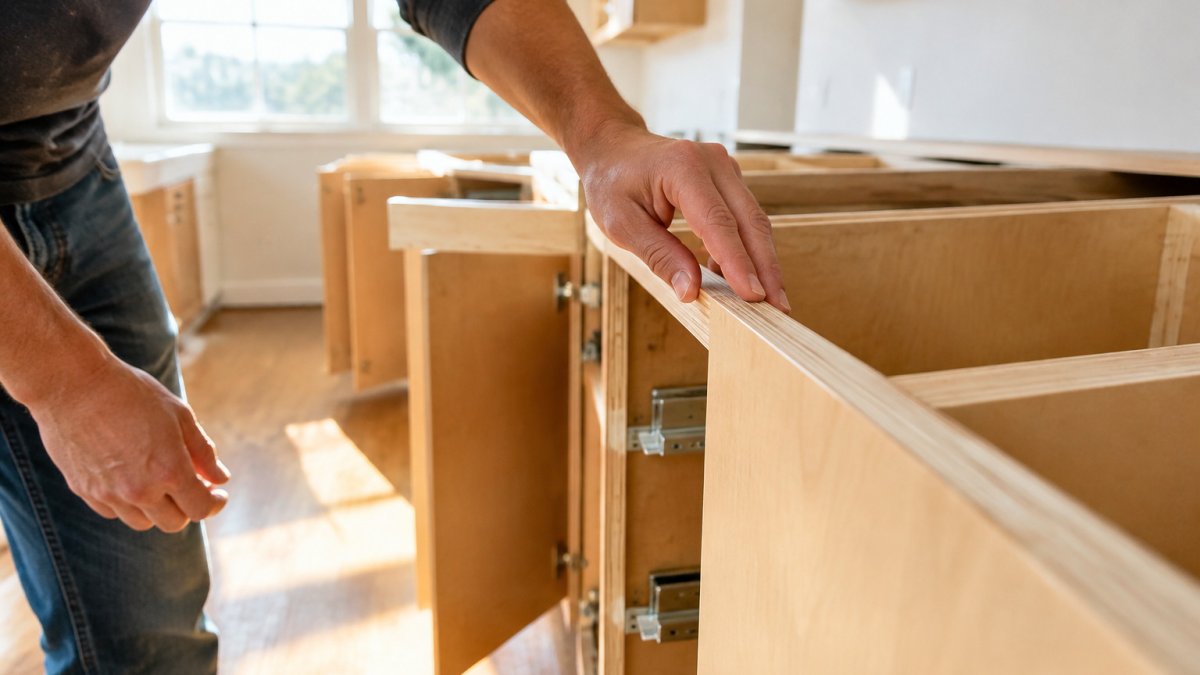
A landlord running a hand along the edge of a plywood cabinet box in a bright, empty rental kitchen with the doors open is a useful way to picture what to check. Look at the exposed edges and ask whether they look like solid layers or compressed chips.
For sink base cabinets especially, plywood construction is worth prioritizing. The added cost is modest compared with the expense of replacing a swollen cabinet mid-lease.
Cabinet Drawer Slide Types and Which Ones Survive Rental Use
Drawer slides are the first component to fail in most rental kitchens, and they are also the cheapest component to specify correctly at purchase. The slide you choose determines how the drawer carries load, how far it opens, and how much impact it absorbs when a tenant slams it shut.
There are three slide families worth knowing:
- Roller slides (side-mount, epoxy-coated). The least expensive option. A nylon or steel roller rides in a channel. They handle light loads, open about three-quarters of the way, and tend to develop a wobble as the roller wears. Fine for a guest-room nightstand, marginal for a kitchen drawer that holds pots.
- Ball-bearing side-mount slides. Steel ball bearings in a race carry more weight than rollers and stay smoother longer. They still mount on the side of the drawer box, so they consume roughly a half-inch of drawer width on each side and are visible when the drawer is open.
- Undermount ball-bearing slides. Mounted beneath the drawer box, hidden from view, and typically the most durable of the three. They require a specific drawer box bottom profile and are less forgiving to install, but they carry heavy loads, self-close reliably, and are the standard on mid-grade and premium cabinets.
Full-extension versus three-quarter extension matters more in a rental than most landlords expect. A three-quarter slide forces tenants to reach into the back of the drawer, which twists the box and stresses the joints. Full-extension slides let the drawer clear the cabinet face, so the load stays centered over the slide.
Soft-close is not a luxury feature in a rental. The mechanism is a small dampener that catches the drawer in the last inch or two of travel. It removes the slam that transmits impact into the slide, the box joints, and the cabinet frame.
Load rating is the number to verify in writing. Slide manufacturers publish a weight capacity per pair, commonly in the range of 75 to 100 pounds for side-mount ball-bearing slides and 100 pounds or more for quality undermount slides.
Two more specifications separate rental-grade slides from builder-grade ones. First, ask whether the slide has a disconnect lever or release tab so a drawer can be removed for cleaning without tools; tenants will pull drawers out anyway, and a tool-free release prevents damaged boxes. Second, confirm that replacement slides in the same model are stocked, because slides wear out before cabinet boxes do and a $15 slide swap is far cheaper than replacing a cabinet.
When you compare quotes, put the slide specification on one line: brand, model, side-mount or undermount, extension length, load rating, and soft-close yes or no. If a quote says only "soft-close drawers," treat the hardware as unknown and price the upgrade before you sign.
The article compares the three drawer slide families and the specifications that matter most in a rental.
| Slide type | Mounting | Key difference |
|---|---|---|
| Roller slides (side-mount, epoxy-coated) | Side of drawer box | Least expensive; light loads; wobble as roller wears |
| Ball-bearing side-mount slides | Side of drawer box | Carries more weight; stays smoother; visible when open |
| Undermount ball-bearing slides | Beneath drawer box | Hidden; most durable; heavy loads; self-closes reliably |
Rental Kitchen Cabinet Colors That Appeal to Tenants and Landlords
Neutral colors, such as white, soft gray, and natural wood tones, appeal to the widest range of tenants. They also hide minor scuffs better than very dark or very bright finishes, which show every mark.
Timeless designs age well. Trendy colors may look fresh at move-in but can make a unit feel dated within a few years, which can affect turnover and rent.
White Oak finishes offer warmth while still reading as neutral. They are a good middle ground for landlords who want something a little more distinctive than plain white.
Total Cost of Ownership and a Checklist for Comparing Cabinet Quotes
The sticker price of a cabinet is the smallest part of what it costs a landlord. Total cost of ownership adds shipping, installation, the repair and replacement events you can expect over the cabinet's service life, and the turnover cost of a kitchen that looks dated or broken.
Build the comparison in four buckets:
- Acquisition. Cabinet price per unit, plus doors, drawer fronts, and any filler or trim. Confirm whether the quote is per cabinet or per linear foot, because the two are not interchangeable.
- Delivery and logistics. Shipping charges, liftgate or inside-delivery fees, and lead time. Free shipping thresholds change the math on a full kitchen; a package that crosses the threshold can beat a lower per-cabinet quote that adds freight.
- Installation. Labor, disposal of old cabinets, patching and paint, and any plumbing or electrical relocation. Installation is often quoted separately and is the line most likely to grow after the walls are opened.
- Service life and repairs. Expected years before replacement, the cost of the most common repair (slides, hinges, a single door or drawer front), and whether matching replacement parts will be available in five years.
A simple way to compare is cost per year of service. Divide the all-in acquisition and installation cost by the expected service life, then add an annual repair allowance. A cabinet package that costs more upfront but lasts several years longer and needs fewer hardware repairs often wins on cost per year, even though it loses on day-one price.
Repairability belongs in the TCO math because it determines whether a failure is a $20 fix or a $400 cabinet replacement. Cabinets built on standard sizes with stocked door and drawer-front profiles can be repaired one component at a time. Cabinets in a discontinued finish or a custom size force a full-cabinet or full-run replacement when one piece is damaged.
Use this checklist to interrogate each quote line by line:
- Box material and thickness. Plywood or particleboard or MDF, and the nominal thickness. Ask for the spec sheet, not a verbal answer.
- Edge banding. How exposed edges are finished, and whether the banding is applied to all four edges or only the front.
- Drawer box construction. Joint type (dovetail, dowel, or stapled), side material, and bottom panel thickness.
- Slide specification. Brand, model, side-mount or undermount, extension, load rating, and soft-close.
- Hinge specification. Brand, model, overlay, and whether soft-close is standard or an upgrade.
- Finish. Material and sheen, and whether touch-up or replacement fronts are stocked.
- Standard sizing. Whether the cabinet is a stock size that can be reordered, and the lead time for a reorder.
- Warranty. What is covered, for how long, and whether it covers hardware separately from the box.
- Shipping and delivery. Freight cost, threshold for free shipping, delivery method, and who handles damage claims.
- Installation scope. What labor is included, what is excluded, and how change orders are priced.
- Sample and return policy. Whether you can see a physical door or finish sample before committing, and the return terms.
Watch out: a quote that lists a cabinet price but not the slide brand, box material, or shipping terms is not comparable to one that does; normalize every bid to the same line items before you compare totals, or the lowest number will usually be the one with the most exclusions.
Finally, budget for the turnover event, not just the install. A kitchen refresh between leases is cheaper than an emergency replacement during a lease, and cabinets specified for repairability let you replace a single damaged drawer front or slide instead of a whole run.
Choosing Your Rental Cabinets and Planning the Installation
Start by measuring the kitchen carefully and listing every base cabinet needed. Standard sizes simplify this step, but confirm clearances for appliances and sink plumbing before ordering.
Plan installation timing around tenant turnover. Replacing cabinets between leases avoids disrupting occupied units and keeps costs predictable.
For a rental kitchen, a durable Shaker-style drawer base in a neutral finish is a strong default. Our team at Frugal Cabinets Online can help you match options to your layout and budget. Plan your project today and compare configurations before you buy.
Plan your rental kitchen with Frugal Cabinets Online and choose cabinets built to handle years of tenant use at a price that protects your budget.
Frequently Asked Questions
What are the best kitchen cabinets for a rental property?
For most rentals, stock or standard-size cabinets with plywood boxes, Shaker-style doors and a durable finish give the best balance of cost and wear resistance. Standard sizes keep replacement doors and parts easy to source, and Shaker doors read as neutral to most tenants. Pair them with soft-close drawer slides and a moisture-resistant sink base, since the sink area takes the most water exposure. Prioritize construction you can repair over decorative features that will age quickly under tenant use.
Are plywood cabinets better than particleboard cabinets for rentals?
Compare the box construction specifically when you review cabinet quotes, and ask the supplier for the material and thickness in writing.
Which drawer slides hold up best in a rental kitchen?
Full-extension drawer slides with a rated load capacity and soft-close action tend to hold up best in rentals, because they reduce slamming and let drawers carry heavy pots without sagging. Check that the slides are matched to the drawer box construction, and confirm the hardware is replaceable so a single failed slide does not require a new cabinet.


